AEO and GEO are no longer fringe disciplines debated at conferences — they are now the operational centre of how serious agencies approach brand discovery in AI search. The numbers behind that shift are no longer soft or directional. They are concrete, and they are accelerating.
What the Data Actually Shows
Start with the behaviour change. When Pew Research Centre analysed 68,879 Google searches in March 2025, users who encountered an AI-generated summary clicked on a traditional result just 8% of the time — compared to 15% for those who saw no summary. A quarter of users who saw an AI summary ended their session without clicking on anything at all. That is not a rounding error. That is a structural shift in how people interact with search results.
The volume story compounds it. BrightEdge reported in May 2025 that Google search impressions climbed 49% in the year following the launch of AI Overviews — while click-throughs dropped nearly 30%. More eyeballs on AI-generated answers, fewer clicks reaching the underlying pages. Impressions are up. Engagement with links is collapsing. The answer itself has become the destination, and the brands inside that answer are the ones getting noticed.
Platform scale reinforces why this matters beyond Google alone. ChatGPT attracted 5.72 billion monthly visits as of January 2026, according to SimilarWeb data — a figure that would have seemed implausible three years ago. AI search is not a parallel channel. It is the primary channel for a growing share of queries.
AEO and GEO: A Distinction Worth Keeping Straight
The terminology has stabilised enough that agencies need to stop using these terms interchangeably. They describe related but distinct problems.
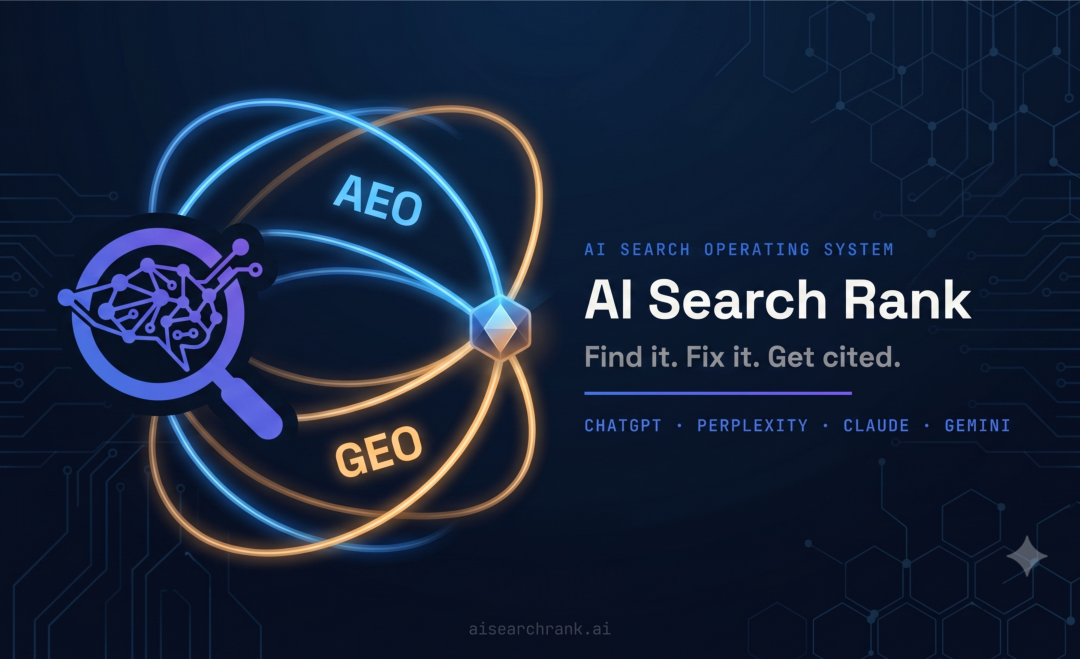
Answer Engine Optimisation (AEO) is about structuring content so AI systems can extract a clean, direct answer. It is primarily on-site work: question-based headings, answer-first paragraphs of 40 to 80 words, FAQ and HowTo schema markup. AEO is the discipline that governs whether your content is machine-readable in the way AI systems require.
GEO operates at a wider radius. Generative engine optimisation is the practice of structuring your content and digital presence so that AI-powered search platforms — including ChatGPT, Google AI Overviews, Perplexity, Claude, and Copilot — can retrieve, cite, and recommend your brand when answering user questions. If traditional SEO was about earning a spot among 10 blue links, GEO is about earning a place among the two to seven domains large language models typically cite in a single response.
The critical insight connecting both disciplines comes from McKinsey. McKinsey’s AI Discovery Survey (August 2025, surveying 1,927 consumers) found that a brand’s own website accounts for only 5 to 10% of the sources AI search platforms reference — with the other 90% coming from publishers, user-generated content, affiliate sites, and review platforms. So your AEO might be flawless on Google, while your GEO presence in the wider web remains thin. That gap is where most brands are currently losing ground.
Where the Agency Market Is Moving
The investment signals are clear. According to Conductor research reported by MarTech in February 2026, 32% of digital marketing leaders now rank GEO as their top priority for the year. That is a remarkable figure for a discipline that barely had a name two years ago.
AI search adoption is moving beyond experimentation as users form platform loyalty, choosing their preferred AI engine the way they once chose between Google and Bing. At the same time, GEO has gone mainstream at the enterprise level, with dedicated conferences, agency specialisations, and a growing ecosystem of purpose-built tools.
The citation advantage data is what is closing the argument for sceptical clients. Seer Interactive’s study found that brands cited in AI Overviews earn 35% more organic clicks and 91% more paid clicks compared to those left out of the summary entirely. That is a business case, not a theory. And it applies equally to AEO and GEO — being inside the answer has measurable downstream commercial value.
One finding that should recalibrate agency thinking on traditional ranking metrics: BrightEdge found that 89% of AI Overview citations come from results ranked beyond position 100. Traditional ranking position is becoming less relevant than content structure and authority signals. The implication is significant. A client sitting outside the top 10 on a given query may still earn AI citation — if their content is structured correctly and their off-site authority is distributed across the right third-party sources.
What Agencies Should Do Now
Two things matter most in the near term.
First, audit the off-site footprint. Given that AI systems draw 90% of their citations from sources other than the brand’s own website, the question is not just “is our content optimised?” but “where does our brand appear across the web, and is that coverage authoritative enough to be cited?” Digital PR, third-party reviews, and earned media placements are no longer soft brand-building activities — they are direct inputs into AI citation probability. Agencies that treat GEO as a purely on-site content exercise are solving the wrong problem.
Second, build measurement before the client asks for it. Treating GEO as a one-time content tweak is the biggest mistake you can make. GEO demands the same ongoing discipline as SEO. The AI search landscape shifts fast — models update, citation patterns change, and competitors adapt. Agencies that establish AI citation monitoring now — tracking which queries surface their clients, which platforms cite them, and how citation frequency moves over time — will have a defensible data advantage over those who start later.
The window for early-mover advantage in AEO and GEO practice is narrowing. The data is in. The client demand is building. The agencies that treat this as a specialism to develop rather than a trend to monitor will be the ones writing the case studies in 2027.
Frequently Asked Questions
What is the difference between AEO and GEO?
AEO (Answer Engine Optimisation) focuses on structuring on-site content so AI systems can extract direct answers — using question-based headings, concise paragraphs, and schema markup. GEO (Generative Engine Optimisation) is broader, covering your entire digital footprint across third-party sources, publishers, and review platforms that AI engines cite.
Why does traditional search ranking matter less for AI citation?
BrightEdge data shows 89% of AI Overview citations come from pages ranked beyond position 100. AI engines prioritise content structure, topical authority, and earned third-party citations over ranking position. A well-structured page with strong off-site signals can earn AI citation even without top-10 organic rankings.
How significant is the commercial impact of being cited in AI search answers?
Seer Interactive found that brands cited in AI Overviews earn 35% more organic clicks and 91% more paid clicks versus brands excluded from the summary. With a quarter of users ending sessions after reading an AI summary without clicking anything, citation inclusion is now a direct commercial variable, not a vanity metric.
Where should agencies start when building an AEO and GEO practice?
Start with an off-site audit. McKinsey data shows AI platforms draw 90% of citations from sources other than a brand’s own website. Mapping where a client’s brand appears across publishers, review sites, and UGC platforms — and identifying gaps — gives you a prioritised GEO workplan grounded in how AI systems actually retrieve information.