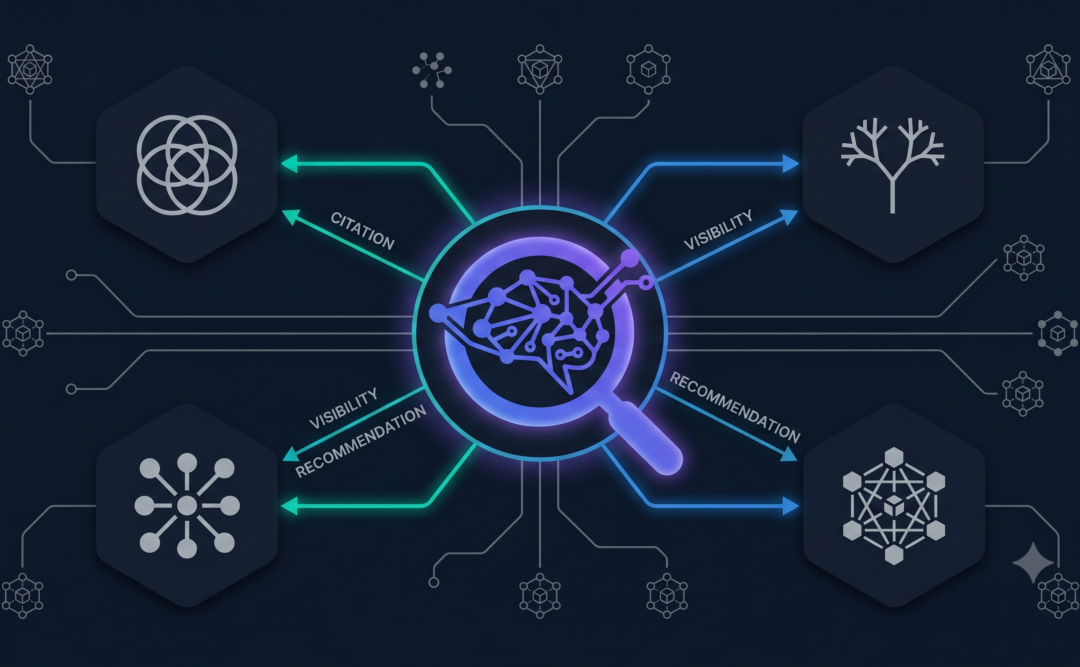
A GEO platform for agencies is a software system that manages generative engine optimisation across multiple client accounts — auditing how clients appear in AI-generated answers, tracking citation share-of-voice across the major AI answer engines (ChatGPT, Perplexity, Claude, and Gemini), diagnosing the entity and schema gaps that suppress visibility, and delivering white-label reports agencies present directly to clients. It is to AI search what a rank-tracking platform is to traditional SEO, with one structural difference: the “result” is a natural-language answer, not a ranked list of URLs, so the unit of success is being cited inside the answer rather than ranked beneath it.
Key Takeaways
- A GEO platform for agencies handles multi-client AI visibility at scale — auditing, tracking, fixing, and reporting on how brands appear inside AI-generated answers.
- The core metrics are citation frequency, share-of-voice against named competitors, and entity recognition accuracy — not keyword rankings or organic clicks.
- A credible platform audits the major conversational answer engines — ChatGPT, Perplexity, Claude, and Gemini — because each retrieves and cites differently; tracking only one gives a misleading picture.
- Entity authority — built from Wikidata entries, schema markup, consistent NAP data, and Knowledge Panel presence — is the primary lever GEO work moves.
- White-label reporting, backed by crawler-log evidence, is the feature that decides whether GEO is a visible service line or an invisible cost centre.
- Because that infrastructure now exists, GEO has become a repeatable, billable retainer service — and agencies without a delivery process for it are losing renewals to those who have one.
GEO, AEO, LLMO: clearing up the terminology first
Because this is a fundamentals guide, it’s worth settling the vocabulary. Generative Engine Optimisation (GEO) is the broad discipline of getting a brand surfaced and cited inside AI-generated answers. Answer Engine Optimisation (AEO) is often used interchangeably, with slightly more emphasis on direct-answer formats and featured snippets. LLMO (large language model optimisation) is the same idea framed around the models themselves. The distinctions are mostly emphasis, not substance — a credible GEO platform addresses all of them, because the underlying work (entity authority, trustworthy sources, extractable content) is identical regardless of the acronym a client arrives with.
Why Agencies Need a Dedicated GEO Platform
Managing AI visibility manually does not scale past a handful of clients. AI engines return different answers to the same question depending on phrasing, geography, device context, and the engine’s own retrieval logic on any given day. Checking whether one client is cited across ten queries in ChatGPT is a fifteen-minute task; doing it across four engines, fifty queries, and thirty clients is a full-time job — and the data is stale before you finish.
A platform automates that loop: it submits structured prompt sets to each engine, parses the responses for brand mentions and the sources cited, and logs results over time so you see trends, not snapshots. That longitudinal record is also what makes the work reportable. Clients paying for AI visibility need evidence it is working, and a keyword-ranking dashboard cannot tell them whether an AI assistant is recommending them. A GEO platform answers the question clients actually ask — “Do we show up when people ask AI about our category?” — with citation rate, competitive share-of-voice, and entity health.
Core Features of an Agency-Grade GEO Platform
The features that separate agency infrastructure from a single-brand tool are multi-tenancy, white-labelling, diagnostic depth, and a verifiable evidence layer.
Multi-client AI visibility auditing. Systematically query each engine with the prompts a client’s audience actually uses, then analyse responses for brand presence, competitor presence, and which sources the engine chose to cite. Run it across every client from one interface, with strict account-level segmentation so data never bleeds between clients.
Citation and share-of-voice tracking over time. A single audit is a baseline; the value is in the trend. Run the same prompt sets on a fixed cadence — weekly is the practical minimum in fast-moving categories, monthly for stable ones — and record whether the client is cited, how prominently, and from which sources. Extend it to the competitive set: if a client is cited in only a handful of relevant answers while a competitor appears in most of them, that gap is the brief for next quarter.
Crawler logs and proof receipts. The feature agencies trust most is the evidence layer. A serious platform records the actual crawler logs and raw answer captures behind every metric — the timestamped prompt, the engine’s verbatim response, and whether the client was cited — so a citation rate is never a number you have to take on faith. These receipts are what let an agency defend its reporting in a client review and prove that a visibility gain is real rather than a sampling artefact.
Entity and schema diagnostics. When an engine doesn’t cite a brand, the cause is almost always an entity problem — it either doesn’t recognise the brand as a distinct entity, or doesn’t trust the sources describing it. A useful diagnostic layer checks concrete signals: presence and validity of Organization, Product, and FAQPage schema (the JSON-LD an engine reads to understand a page); a resolved Wikidata entry and Knowledge Panel; consistent sameAs links and NAP (name, address, phone) data across directories; and the quality of the third-party pages that mention the brand. It should hand you specific, prioritised fixes — not just a score.
White-label reporting. Clients don’t want to log into another vendor’s dashboard. White-label means your branding on every output, per-client configurable metrics, and exports that drop into existing workflows — PDF for executive summaries, raw data for analysts. This is the feature that keeps GEO a visible, renewable service rather than a cost buried in an invoice.
Human-in-the-loop publishing. The strongest platforms help you fix what they diagnose: schema updates, entity-disambiguation pages, FAQ content structured for clean AI extraction, and outreach to the sources engines trust. “Human-in-the-loop” means a practitioner reviews and approves each change before it goes live — essential for brand-sensitive clients. Fully automated publishing without review is a liability, not a feature.
How GEO Platforms Differ From Traditional SEO Tools
SEO tools and GEO platforms measure fundamentally different things, and conflating them leads agencies to under-tool the work.
A rank tracker measures a brand’s position in a list of URLs: search, ranked links, click. A GEO platform measures a brand’s presence inside a synthesised answer: ask, generated response, read — often with no click at all. In that second model, being cited is the conversion event — and a brand can rank first organically while being entirely absent from the AI answer rendered above its blue link. That isn’t hypothetical: AI Overviews, Perplexity’s answer pages, and ChatGPT’s browsing responses already satisfy a large share of research queries without sending a click anywhere. An agency tracking only rankings is measuring the wrong surface for a growing slice of its clients’ exposure.
What GEO Platforms Actually Optimise Against
The levers are different from SEO’s, and naming them keeps client expectations honest. Whether an engine cites a brand comes down to four things. Entity authority is the largest: how completely and consistently the brand exists as a recognised entity — a resolved Wikidata item, accurate Knowledge Panel, valid Organization schema, and consistent NAP data across the web. Source trustworthiness is whether the pages mentioning the brand are ones the retrieval layer treats as credible. Content structure is whether the brand’s own pages are formatted — with clean headings and FAQPage/JSON-LD markup — for easy extraction. Topical relevance is whether the brand is associated with the right concepts in the model’s world view. A GEO platform surfaces diagnostics across all four and sequences the fixes that move citation metrics fastest.
What these platforms do not move: click-through rate, organic traffic volume, or keyword position — those stay SEO metrics. Be explicit with clients about the split, or you’ll field confused questions when AI visibility climbs while organic traffic stays flat. That divergence is normal, not a failure.
The Agency Delivery Model Around a Platform
A platform is infrastructure, not a strategy. The agencies that get the most from it wrap a repeatable process around it: an onboarding audit that sets a baseline, a monthly or quarterly cycle that works through the diagnostic backlog, and a reporting rhythm that informs clients without drowning them in data they can’t act on.
Treat GEO as a standing retainer, not a one-off project — engine behaviour shifts, new surfaces gain share, and competitors invest in their own programmes, so the work is continuous. Platforms like AI Search Rank are built for exactly this retainer model, providing the multi-client infrastructure, longitudinal tracking, crawler-log evidence, and white-label reporting that make GEO operationally viable across a full client portfolio.
Choosing a GEO Platform: What to Evaluate
The questions that matter are practical. Does it audit the major answer engines — ChatGPT, Perplexity, Claude, and Gemini — or just one? Does it give you crawler logs and raw answer captures, or only summary scores you can’t verify? Will it handle your client count and query volume without per-query pricing that breaks the economics at scale? Is the white-labelling genuinely seamless, or does vendor branding leak into the output? Does the diagnostic layer return actionable fixes? And does the vendor update its methodology when engines change retrieval behaviour — because they do, often? Tools built for a single brand and retrofitted with a client layer tend to show the seams under agency workloads.
What This Means for Your Agency Right Now
GEO isn’t a service line to watch; it’s one to be delivering. Clients raise AI visibility in nearly every strategy conversation, and the agencies that can show citation data, share-of-voice trends, and a clear optimisation roadmap are winning those conversations from the ones that can’t. The practical next step is small: pick five high-intent queries for one client, check how often they’re cited across the major engines today, and use that baseline to decide whether your current tooling can run it across your whole book of business. That single exercise usually answers the platform question faster than any feature comparison.
Frequently Asked Questions
What is a GEO platform for agencies?
Software that manages generative engine optimisation across multiple client accounts. It automates AI visibility auditing, tracks citation share-of-voice across the major answer engines — ChatGPT, Perplexity, Claude, and Gemini — diagnoses entity and schema gaps, and produces white-label reports agencies present directly to clients.
How is a GEO platform different from an SEO tool?
SEO tools measure keyword rankings and organic traffic — position in a list of URLs. GEO platforms measure citation presence inside AI-generated answers. A brand can rank first organically and still be absent from the AI answer above it, so the two require distinct measurement infrastructure.
Which AI engines should a GEO platform track?
The major conversational answer engines: ChatGPT, Perplexity, Claude, and Gemini. Each retrieves and cites differently, so tracking only one or two gives an incomplete picture. (Google’s AI Overviews and Microsoft Copilot are part of the broader answer landscape; the four conversational engines are simply where most agencies focus today.)
What metrics does a GEO platform report on?
Citation frequency (how often a brand appears in answers to relevant queries), share-of-voice against competitors, entity recognition accuracy, and citation source quality — ideally backed by crawler logs so each figure is verifiable. These replace keyword ranking as the primary indicators for AI search visibility.
How much does a GEO platform for agencies typically cost?
Pricing varies by platform, query volume, and number of accounts managed, and is typically quoted in USD. Agency-tier plans are usually structured as monthly retainers rather than per-query pricing, which keeps costs predictable at scale. Comparing total cost against clients and engines covered is the most reliable way to evaluate options.
Can an agency deliver GEO without a dedicated platform?
Technically yes, but not at scale. Manual checks across multiple engines, dozens of queries, and many clients are operationally unsustainable; without longitudinal tracking there’s no trend to show clients, and without white-label reporting the work stays invisible. A dedicated platform is what makes GEO a viable managed service.