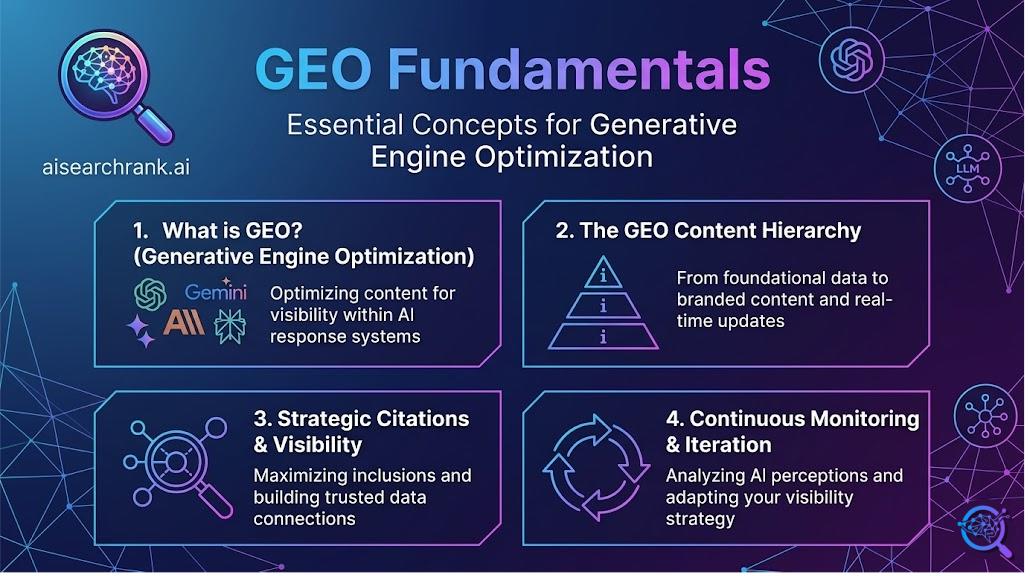
GEO Fundamentals
How GEO Differs from Traditional SEO
Generative Engine Optimisation and traditional SEO share some foundations — quality content, credible backlinks, technical hygiene — but they optimise for fundamentally different outcomes. Traditional SEO targets blue-link rankings: the goal is to appear in a ranked list of pages that a user then chooses to click. The signals that drive those rankings — keyword density, page authority, crawlability, click-through rate — are well-understood and measurable through established tooling.
GEO targets citation in AI-generated answers: the goal is to be the source an AI engine names, quotes, or recommends when synthesising a response. The signals that drive citation are different. AI engines weight entity clarity, third-party corroboration, and content extractability — not keyword matching. A brand can hold a first-page Google ranking and be entirely absent from ChatGPT, Perplexity, Claude, and Gemini answers on the same topic. These are now separate problems requiring separate diagnostics and separate remediation.
The most important practical difference is measurement. Traditional SEO performance is visible in rank tracking tools and Google Search Console. AI citation behaviour is not captured by any of that tooling. A brand’s presence or absence in AI answers is invisible to legacy dashboards, which means agencies running traditional SEO reporting have no signal on a channel that is now handling a significant and growing share of commercial queries.
How GEO Differs from AEO
Answer Engine Optimisation and Generative Engine Optimisation are complementary disciplines that address different parts of the same problem — and conflating them leads agencies to underserve clients on both.
AEO is on-site work. It is the practice of structuring a brand’s own content so AI engines can extract and cite it directly. This means answer-first content architecture — leading every section with a direct, liftable response rather than burying the point in discursive prose. It means FAQPage schema markup, which gives engines pre-formatted question-and-answer pairs. It means descriptive headings that map to the queries users actually ask. AEO governs what happens on pages the brand controls.
GEO is off-site work. It is the practice of building the external authority signals that cause AI engines to trust and cite a brand in the first place — regardless of what the brand’s own pages say. This means earning credible third-party mentions in trade publications and industry directories. It means maintaining a clean, consistent entity record across Wikidata, Google Business Profile, and major citation databases. It means structured outreach that places the brand in independent, authoritative contexts. GEO governs how the broader web talks about a brand.
Both are necessary. AEO without GEO produces well-structured content that no engine is confident enough to cite. GEO without AEO produces external authority that points back to pages engines cannot extract answers from. The brands that appear consistently in AI answers have closed both gaps.
The Three Gaps That Cause AI Search Invisibility
Most brands that are invisible in AI search are not invisible because they lack content. They are invisible because they have one or more of three distinct gaps, each of which requires a different remedy.
The first is the entity gap. The AI engine cannot confidently resolve who the brand is — what it does, who it serves, where it operates. This happens when the brand’s identity signals are inconsistent or absent: schema markup that contradicts directory listings, a name spelled differently across platforms, no Wikidata entry, no Google Knowledge Panel. The engine encounters the brand across multiple sources but cannot reconcile them into a coherent entity, so it defaults to a competitor it can resolve cleanly.
The second is the content structure gap. The engine knows the brand exists but cannot extract a clear, citable answer from its pages. Content written for persuasion — three paragraphs of context before the main point — cannot be lifted verbatim by an AI engine. The fix is answer-first restructuring: the direct response in the first sentence of every relevant section, descriptive headings, FAQPage schema.
The third is the citation gap. The engine has no independent corroboration of the brand’s authority. Everything it finds about the brand comes from the brand itself — its own website, its own press releases, its own social profiles. AI engines weight independent, third-party sources heavily when deciding what to cite. A brand with no external mentions is, from the engine’s perspective, making unverified claims about itself.
What GEO Looks Like in Practice for Agencies
For agencies, GEO is not a one-time deliverable — it is a diagnostic and maintenance discipline that sits alongside traditional SEO as a permanent service layer.
In practice, a GEO engagement starts with a baseline audit: sampling queries across ChatGPT, Perplexity, Claude, and Gemini to establish where the client currently appears, how accurately they are described, and which competitors are displacing them. That audit identifies which of the three gaps — entity, content structure, or citation — is the dominant issue for that client. The gap distribution varies significantly by industry and business type, which is why a generic GEO checklist produces unreliable results.
Remediation then follows the gap. Entity gaps require Wikidata work, directory audits, and schema corrections. Content structure gaps require on-page restructuring and FAQPage schema implementation. Citation gaps require earned media outreach — placing the brand in credible, independent third-party contexts through trade press, industry directories, and authoritative review platforms.
Ongoing management means running the audit on a repeating cadence — monthly at minimum — because AI citation behaviour is not static. A competitor earning a new wave of press coverage, a directory listing going stale, or a model update can shift citation patterns within weeks. The agencies building durable GEO practices are those treating it as a measurement discipline with a regular reporting cycle, not a project with a defined end date. Citation share of voice tracked over time is the metric that makes the retainer conversation defensible.
How to Measure GEO Performance
GEO performance is measured through citation share of voice — the frequency with which a brand appears in AI-generated answers to relevant queries, relative to competitors, across the major conversational engines.
The measurement process starts with a structured query set: a defined list of queries the brand wants to appear in, covering category questions, problem-solution questions, and brand-direct questions. Those queries are run across ChatGPT, Perplexity, Claude, and Gemini on a regular cadence. For each query, the output is recorded: did the brand appear, how was it described, which competitors were cited, and were any claims inaccurate or missing.
From that data, three metrics matter most. Citation frequency is the baseline — how often the brand appears across the full query set. Citation accuracy tracks whether the brand is described correctly when it does appear — a brand that is cited but mischaracterised has a different problem than one that is absent entirely. Competitive share of voice shows the brand’s citation rate relative to the two or three competitors most frequently appearing in the same answer set.
These metrics do not appear in Google Search Console, Ahrefs, or any traditional SEO dashboard. They require purpose-built sampling across AI engines — either manual spot-checking, which does not scale, or a platform that runs structured query sets automatically and tracks trends over time. The measurement gap is why most agencies currently have no signal on a channel that is already influencing client revenue. Establishing the baseline is the first move — everything else in GEO is measured against it.
What Is Generative Engine Optimisation (GEO)?
Generative Engine Optimisation (GEO) is the practice of building a brand’s off-site authority, third-party citations, and content structure so AI answer engines — ChatGPT, Perplexity, Claude, and Gemini — recommend and cite it in their responses. It is distinct from traditional SEO, which optimises for blue-link rankings, and from Answer Engine Optimisation (AEO), which focuses on on-site content structure. GEO is the off-site, authority-building discipline that determines whether an AI engine trusts a brand enough to surface it unprompted.
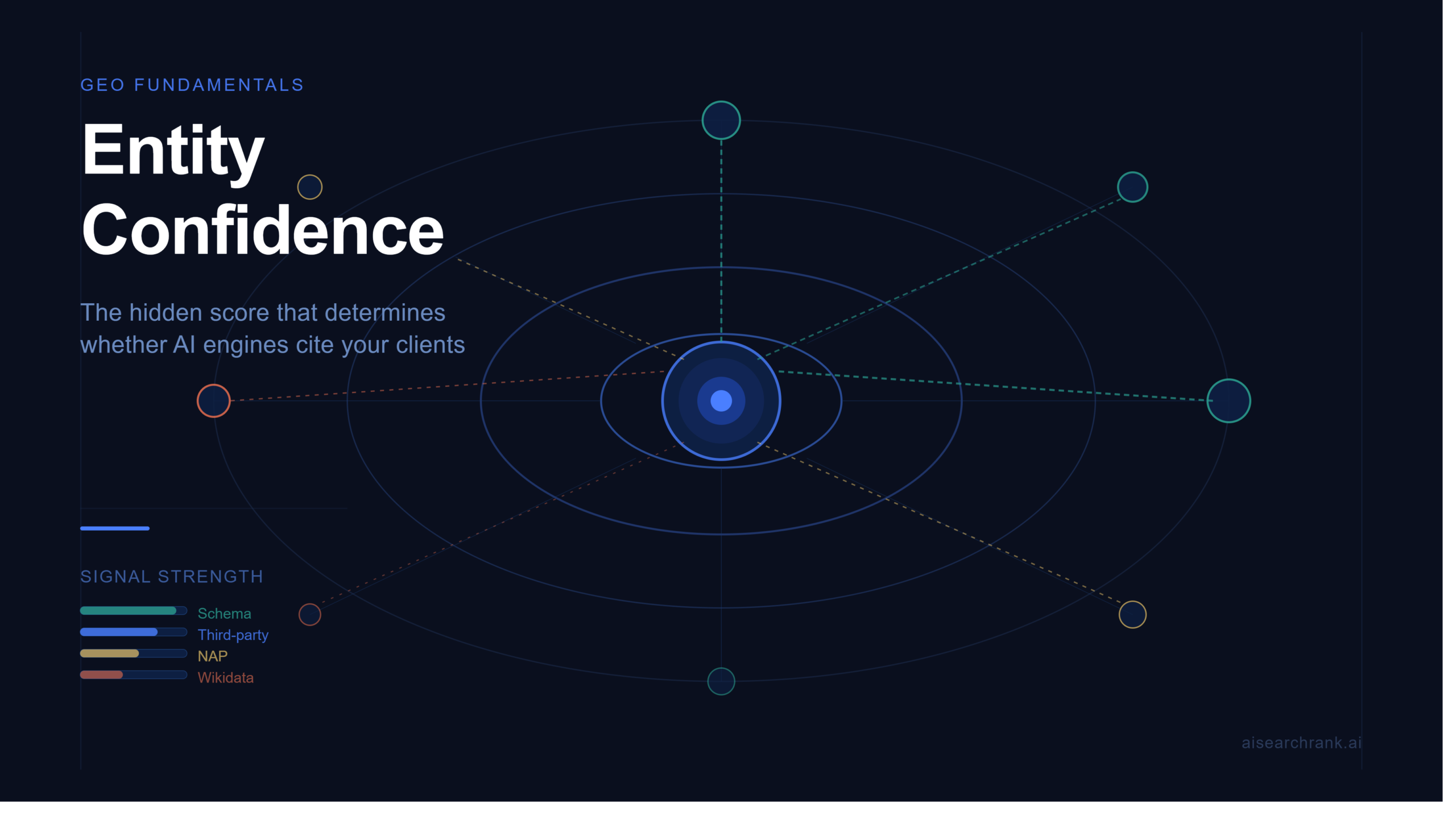
Entity Confidence: The Hidden Score That Determines Whether AI Engines Cite Your Clients
AI engines do not operate with a binary switch — cited or not cited. They hold a continuous, probabilistic assessment of how well they understand a brand: what it does, who it serves, where it operates, and whether third-party sources corroborate that picture. Call…
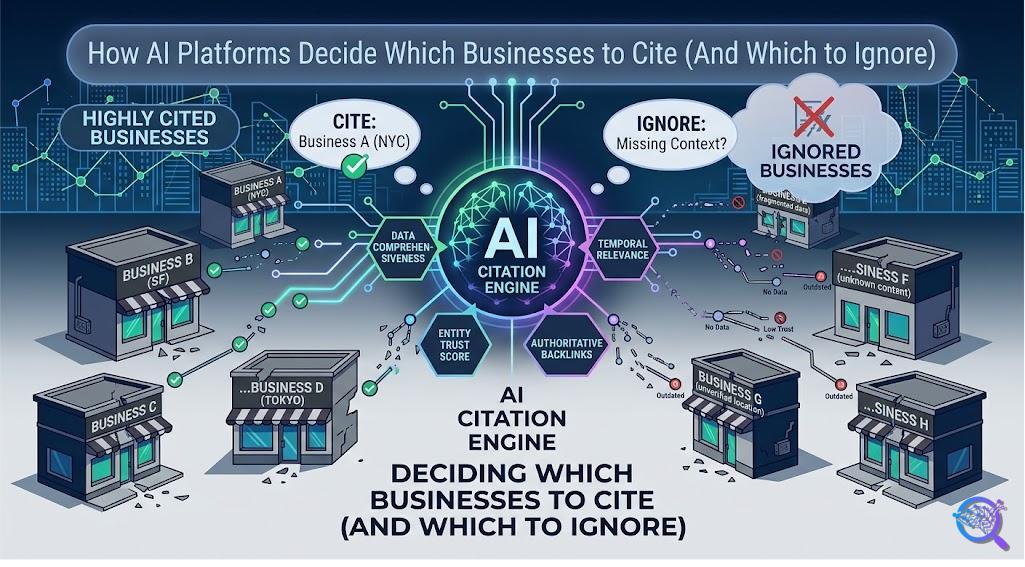
How AI Platforms Decide Which Businesses to Cite (And Which to Ignore)
AI platforms cite businesses that have three things in common: a well-defined entity that the model can confidently identify, structured content it can extract a clean answer from, and third-party validation that corroborates the brand’s authority in its category. If…
What Is a GEO Platform for Agencies? The Complete Guide
A GEO platform for agencies is a software system that manages generative engine optimisation across multiple client accounts — auditing how clients appear in AI-generated answers, tracking citation share-of-voice across the major AI answer engines (ChatGPT,…
Frequently Asked Questions
What is generative engine optimization?
Generative Engine Optimization (GEO) is the practice of building a brand’s off-site authority, third-party citations, and content structure so AI answer engines — ChatGPT, Perplexity, Claude, and Gemini — recommend and cite it in their responses. It is distinct from traditional SEO, which optimizes for blue-link rankings, and from Answer Engine Optimisation (AEO), which focuses on on-site content structure. GEO is the off-site, authority-building discipline that determines whether an AI engine trusts a brand enough to surface it unprompted.
How is GEO different from SEO?
Traditional SEO targets keyword rankings in blue-link search results. GEO targets citation in AI-generated answers. The signals are different — AI engines weight entity clarity, third-party corroboration, and content extractability rather than keyword matching and page authority. A brand can rank on page one of Google and be entirely absent from ChatGPT, Perplexity, Claude, and Gemini answers on the same topic. These are separate problems requiring separate diagnostics and separate remediation workflows.
How is GEO different from AEO?
AEO is on-site work — structuring a brand’s own content so AI engines can extract and cite it directly. GEO is off-site work — building the external authority signals that cause AI engines to trust and cite a brand in the first place. AEO without GEO produces well-structured content that no engine is confident enough to cite. GEO without AEO produces external authority that points back to pages engines cannot extract answers from. Both are necessary for consistent AI search visibility.
What causes a brand to be invisible in AI search?
There are three root causes. The entity gap means the AI engine cannot confidently resolve who the brand is—inconsistent schema, contradictory directory listings, and no Wikidata presence all fragment the entity signal. The content structure gap means the engine knows the brand exists but cannot extract a clear answer from its pages—content written for persuasion rather than extraction is the most common cause. The citation gap means the engine has no independent third-party corroboration of the brand’s authority. All three gaps require different remedies and should be audited separately.
How do agencies measure GEO performance?
GEO performance is measured through citation share of voice — how frequently a brand appears in AI-generated answers to a defined set of relevant queries, relative to competitors, across ChatGPT, Perplexity, Claude, and Gemini. A structured query set is run on a repeating cadence, tracking citation frequency, citation accuracy, and competitive share of voice over time. This data does not appear in traditional SEO dashboards — it requires purpose-built sampling across AI engines, either manually or through a platform that automates the tracking and surfaces trends across a client roster.