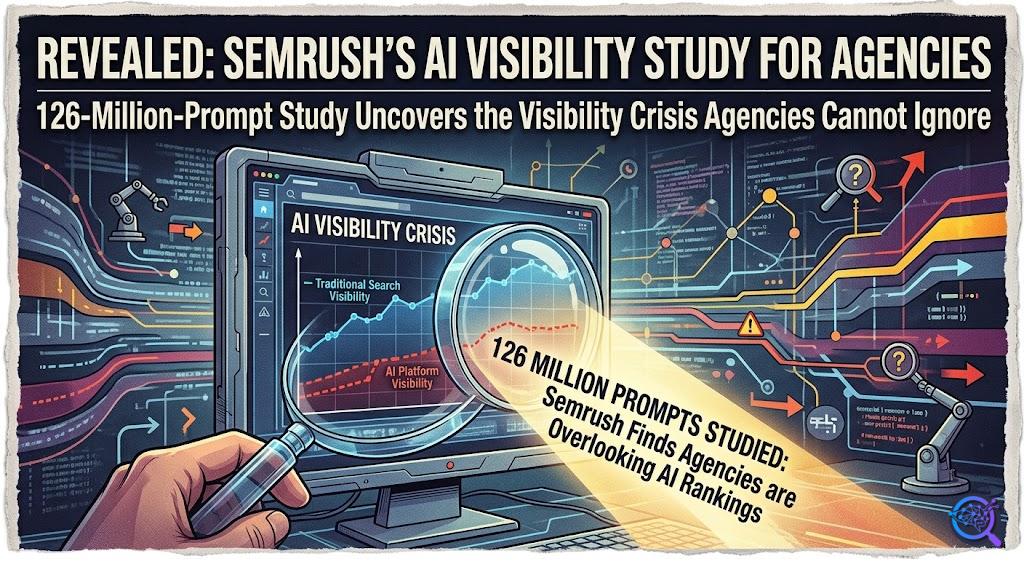
On 26 June 2026, Semrush — an Adobe company — published the 2026 AI Visibility Index, a flagship study built from 126 million U.S. AI search prompts collected between January and April 2026 across ChatGPT, Google Gemini, Google AI Mode, and Google AI Overviews. The report, announced via a BusinessWire press release and available at ai-visibility-index.semrush.com, is the largest published analysis of brand visibility inside AI-generated answers to date. Its headline finding is stark: 45% of marketing leaders cannot accurately measure their brand's presence in AI-generated answers, and only 9% have the tools to track all relevant metrics across platforms.
Key Takeaways
- Scale: The study scaled from an initial 2,500 prompts (September 2025) to 126 million U.S. AI search prompts analysed from January through April 2026, benchmarking more than 1,200 brands across 22 industry verticals. (Source: Semrush newsroom, 26 June 2026)
- Measurement gap: Semrush found that 45% of marketing leaders cannot accurately measure their brand visibility within AI-generated answers, while only 9% have the tools to track all relevant metrics across platforms. (Source: Semrush / BusinessWire press release, 26 June 2026)
- The "Universal 36": Despite being tested across four platforms over four months, only 36 global brands maintained top-100 visibility on every platform in every month of the study — a group Semrush calls the "Universal 36," which includes YouTube, Google, Reddit, Amazon, Facebook, Apple, Walmart, Disney, and Nintendo. (Source: Semrush newsroom, 26 June 2026)
- Mentions ≠ citations: Being mentioned in an AI-generated answer does not mean a brand's own website is cited as the supporting source. On Gemini, the overlap between mentioned brands and cited domains can be as low as 30%. (Source: Semrush / WorldBusinessOutlook, 30 June 2026)
- Integration gap: Among organisations that fully integrate SEO and AI visibility into a unified workflow, 81% reported increased traffic or leads from AI platforms — compared with only 36% among those managing the two areas separately. (Source: Semrush / BusinessWire press release, 26 June 2026)
What the Study Found
The 2026 AI Visibility Index establishes benchmarks across 22 industries and reveals that AI visibility is highly concentrated in some categories and more distributed in others. In News and Media, the three most visible brands accounted for 82.9% of total category visibility; in Consumer Electronics, the top three represented 76.9%. By contrast, Finance and Industrial categories showed the top three brands holding 41.4% and 42.2% respectively — suggesting more room for challengers to gain ground in those verticals.
The study also documents a structural distinction that matters enormously for agency strategy: mentions and citations are not the same metric. A brand can appear frequently in AI-generated answers while its own domain is rarely, if ever, cited as a source. Semrush found that on Gemini, the overlap between mentioned brands and cited domains can be as low as 30% — meaning a brand could be named in seven out of ten answers yet have its website cited in fewer than three. This is the core of what practitioners working in what answer engine optimisation is and what generative engine optimisation is have been tracking: owning your brand narrative inside AI answers requires both on-site extractability and off-site authority.
Third-party sources are now decisive. The study finds that AI platforms rely on customer reviews, community discussions, independent publishers, retailers, and industry sources — not just owned websites — to understand and recommend brands. Patagonia is cited as a case study: the brand maintained an AI visibility score of approximately 79–80 throughout the study period, supported by consistent descriptions across sources including OutdoorGearLab, REI, Switchback Travel, GearJunkie, and Reddit.
Platform behaviour also diverges sharply. According to a companion analysis of the Index's data, ChatGPT averages 15 sources per response and favours community platforms such as Reddit, while Gemini averages 3 sources from a smaller pool including Wikipedia and YouTube. On Google AI Overviews, YouTube dominated at 35.2 million mentions — more than double the next brand, Reddit, at 15.2 million. A brand visible on one engine can be effectively invisible on another, which means per-engine measurement is not optional.
The Agency "So What"
The measurement gap is the most operationally urgent finding for agencies. Nearly half of marketing leaders are spending on AI optimisation without any reliable signal of whether it is working. For agencies managing multiple clients, this is a liability: if you cannot show a client where they appear — or do not appear — across ChatGPT, Gemini, Google AI Mode, and AI Overviews, you cannot demonstrate the value of the work. AI citation and share-of-voice tracking across all four major platforms is no longer a premium add-on; it is the baseline reporting layer.
The integration finding reinforces this. The 45-percentage-point gap between integrated teams (81% reporting AI-driven traffic gains) and siloed teams (36%) maps directly onto how agencies are structured. Agencies that treat AI visibility as a separate workstream from SEO and content are, according to Semrush's own data, delivering materially worse outcomes for clients. The practical implication: AI visibility work needs to be embedded into existing SEO and content retainers, not sold as a standalone product.
The concentration data also creates a clear pitch for clients in Finance and Industrial verticals. With the top three brands holding only around 41–42% of AI visibility in those categories, there is measurable room for a well-executed generative engine optimisation services programme — built on third-party citations, earned media, and community presence — to move a brand into the top tier.
Action This Week
Three concrete steps agencies should take before the end of this week:
- Run a per-engine visibility audit for your top five clients. Query each client's category-level buying questions (not brand-name searches) across ChatGPT, Gemini, Google AI Mode, and AI Overviews. Record whether the client appears, where in the answer, and which third-party sources the engine cites. This is the baseline the Semrush data says 45% of marketing leaders do not have.
- Map the mention-vs-citation gap. For any client who appears in AI answers, check whether their own domain is being cited as a source. A high mention rate with a low citation rate signals that the brand's on-site content is not structured for AI extraction — an answer engine optimisation services audit is the right next step.
- Audit third-party footprint. The Semrush data confirms that AI platforms rely heavily on reviews, community discussions, and independent publishers. Identify which third-party sources are currently driving competitor visibility in your clients' categories, then build a plan to earn presence on those same sources.
Agencies managing AI visibility across multiple clients under their own brand should also review the white-label programme for agencies, which provides the per-engine tracking infrastructure the Semrush study identifies as the critical missing layer.
Start by finding out exactly where your clients stand today: run a free AI visibility audit across ChatGPT, Perplexity, Claude, and Gemini — and bring verified data to your next client meeting.
Frequently Asked Questions
What is the Semrush 2026 AI Visibility Index?
It is a flagship study published by Semrush on 26 June 2026, analysing 126 million U.S. AI search prompts collected from January through April 2026 across ChatGPT, Google Gemini, Google AI Mode, and Google AI Overviews. It benchmarks brand visibility across 22 industries and more than 1,200 brands.
What does the study mean for agencies managing client SEO?
The study found that organisations integrating SEO and AI visibility into a unified workflow were 2.25x more likely to report increased traffic from AI platforms than those managing them separately (81% vs 36%). Agencies that silo AI visibility from core SEO retainers are delivering measurably worse outcomes, according to Semrush's companion survey data.
Why do brand mentions and citations need to be tracked separately?
Being mentioned in an AI answer does not mean a brand's website is cited as a source. On Gemini, the overlap between mentioned brands and cited domains can be as low as 30%. Tracking both metrics separately reveals whether a brand has an authority gap — named by AI but not trusted enough to be sourced.
Which industries have the most open AI visibility opportunity right now?
According to the 2026 AI Visibility Index, Finance and Industrial categories show the top three brands holding only around 41–42% of total category visibility — significantly less concentrated than News and Media (82.9%) or Consumer Electronics (76.9%). Semrush notes these less concentrated categories may offer greater opportunity for brands to gain visibility.