AI Search Intel
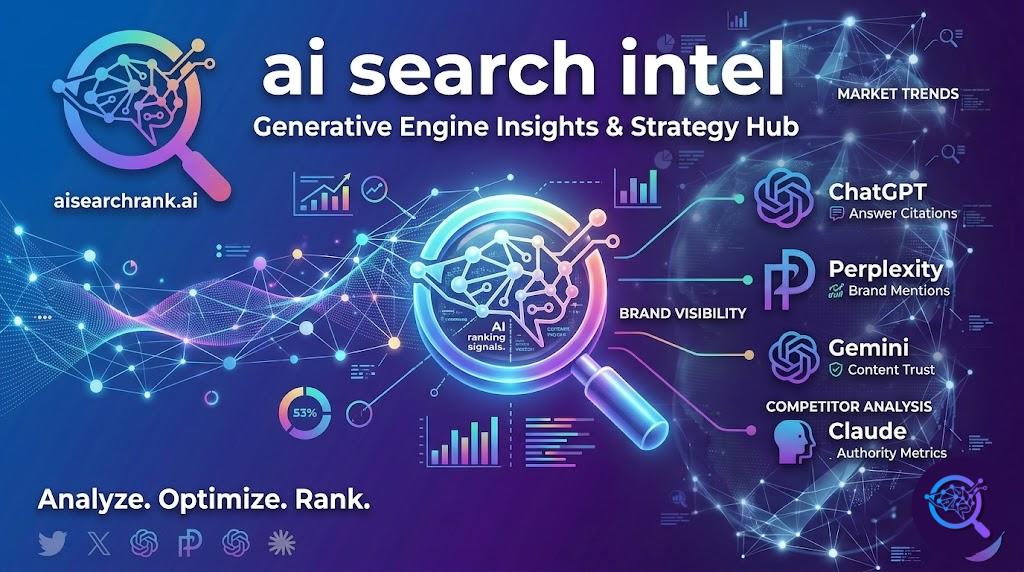
How AI Search Engines Select and Update Their Citation Sources
AI search engines do not index the web the way Google does. They synthesise answers from a combination of training data, retrieval-augmented generation, and real-time web sampling — and the weighting between those layers varies by engine and changes with each model update. ChatGPT with browsing enabled draws on live web results but filters heavily by domain authority and recency. Perplexity operates as a near-real-time retrieval engine and is more sensitive to fresh third-party coverage than any other major platform. Claude and Gemini weight training data more heavily for established entities, making corroboration from credible historical sources a stronger signal than recent coverage alone. Understanding which layer each engine is drawing from for a given query type is the starting point for diagnosing why a brand appears in one engine and not another.
What Model Updates Mean for Citation Behaviour
Every major model update — GPT-4o, Gemini 1.5, Claude 3.5 — has shifted citation patterns in ways that are invisible to traditional SEO monitoring. A brand that held consistent citation share across a query set can drop out of answers entirely after a model update without any change to its own content or backlink profile. The cause is usually a recalibration of how the model weights entity confidence, third-party corroboration, or content extractability. Agencies need to treat model updates the same way they treat Google algorithm updates: run a citation audit in the week following any major release, compare against the pre-update baseline, and identify which clients have shifted and in which direction. The engines do not publish update schedules, so the monitoring cadence has to be regular enough to catch shifts within two to four weeks.
The Difference Between AI Overviews and Conversational AI Citations
Google AI Overviews and conversational AI engines — ChatGPT, Perplexity, Claude, Gemini — are different products with different citation mechanics, and conflating them produces confused strategy. AI Overviews sit inside Google Search and draw primarily from pages Google has already indexed and ranked highly. Optimising for AI Overviews is closer to traditional SEO — E-E-A-T, structured content, featured snippet optimisation — with the addition of FAQPage schema and answer-first formatting. Conversational AI engines operate outside Google’s index entirely and weight entity trust, third-party corroboration, and training data differently. A brand can dominate AI Overviews and be invisible in Perplexity and ChatGPT simultaneously. Both channels matter; neither substitutes for the other.
How to Track AI Search Behaviour Across Engines
Tracking AI search behaviour requires a structured sampling methodology, not passive monitoring. The core approach is a fixed query set — covering category questions, problem-solution questions, and brand-direct questions relevant to each client — run across all four engines on a consistent cadence. Each run records citation presence, citation accuracy, and which competitors appear in the same answer. The aggregate builds a trend dataset that surfaces shifts caused by model updates, competitor activity, or remediation work. The tools that most agencies currently use — rank trackers, Search Console, Ahrefs — produce no signal on any of this. The gap between what agencies can see in existing dashboards and what is actually happening in AI search is the central intelligence problem this pillar addresses.
What the Competitive Landscape in AI Search Looks Like Right Now
The AI search landscape is consolidating around four primary engines — ChatGPT, Perplexity, Claude, and Gemini — but the citation behaviour across them is not uniform and is not stabilising. Perplexity is growing fastest in research and commercial queries and is the engine most sensitive to recent third-party coverage. ChatGPT handles the broadest query volume and has the strongest brand recognition but is also the most conservative in citing smaller or newer brands. Gemini is tightening its integration with Google’s knowledge graph, making entity consistency across Google properties increasingly important. Claude weights corroboration from authoritative editorial sources heavily. For agencies, the practical implication is that a single remediation strategy does not produce uniform results across all four engines — the gap analysis has to be run per engine, and the remediation prioritised by where the client’s target audience is most active.
AI Search Intel
AI search engines are not staticModel updates shift citation behavior, new engines gain market share, and the signals that drive recommendations change faster than any traditional SEO monitoring tool can detect. AI Search Intel covers what is actually happening inside ChatGPT, Perplexity, Claude, and Gemini: how they select sources, what changes with each model update, and what agencies need to watch to stay ahead of shifts that are invisible in legacy dashboards.
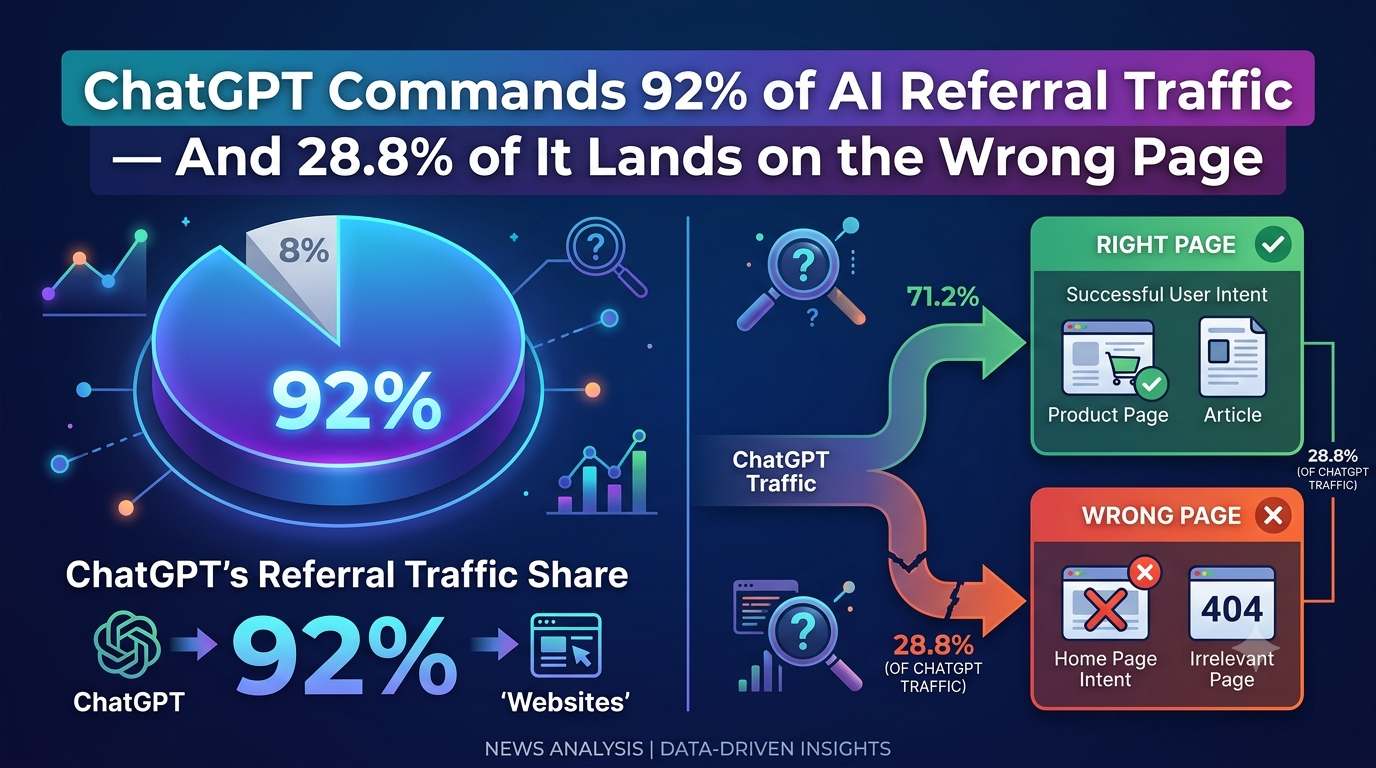
ChatGPT Commands 92% of AI Referral Traffic — And 28.8% of It Lands on the Wrong Page
Previsible released its third AI Traffic Study on 6 July 2026 via BusinessWire, analysing 6.77 million LLM-driven sessions across 166 websites spanning November 2024 through May 2026. The headline finding: ChatGPT commands 92.4% of all trackable standalone AI referral…
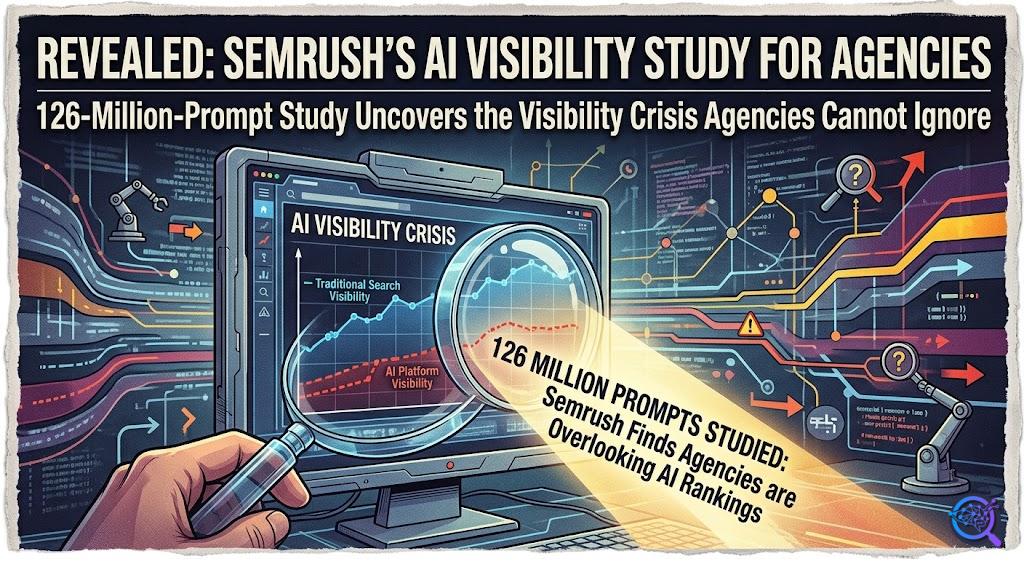
Semrush’s 126-Million-Prompt Study Reveals the AI Visibility Crisis Agencies Cannot Ignore
On 26 June 2026, Semrush — an Adobe company — published the 2026 AI Visibility Index, a flagship study built from 126 million U.S. AI search prompts collected between January and April 2026 across ChatGPT, Google Gemini, Google AI Mode, and Google AI Overviews. The…
The Munich Ruling Changes What AI Search Visibility Actually Means for Your Clients
Your client’s brand can now be defamed at scale by an AI answer engine — and the company running that engine may be legally responsible for it. That is the practical consequence of a landmark ruling handed down in Munich on 9 June 2026, and it reframes what…
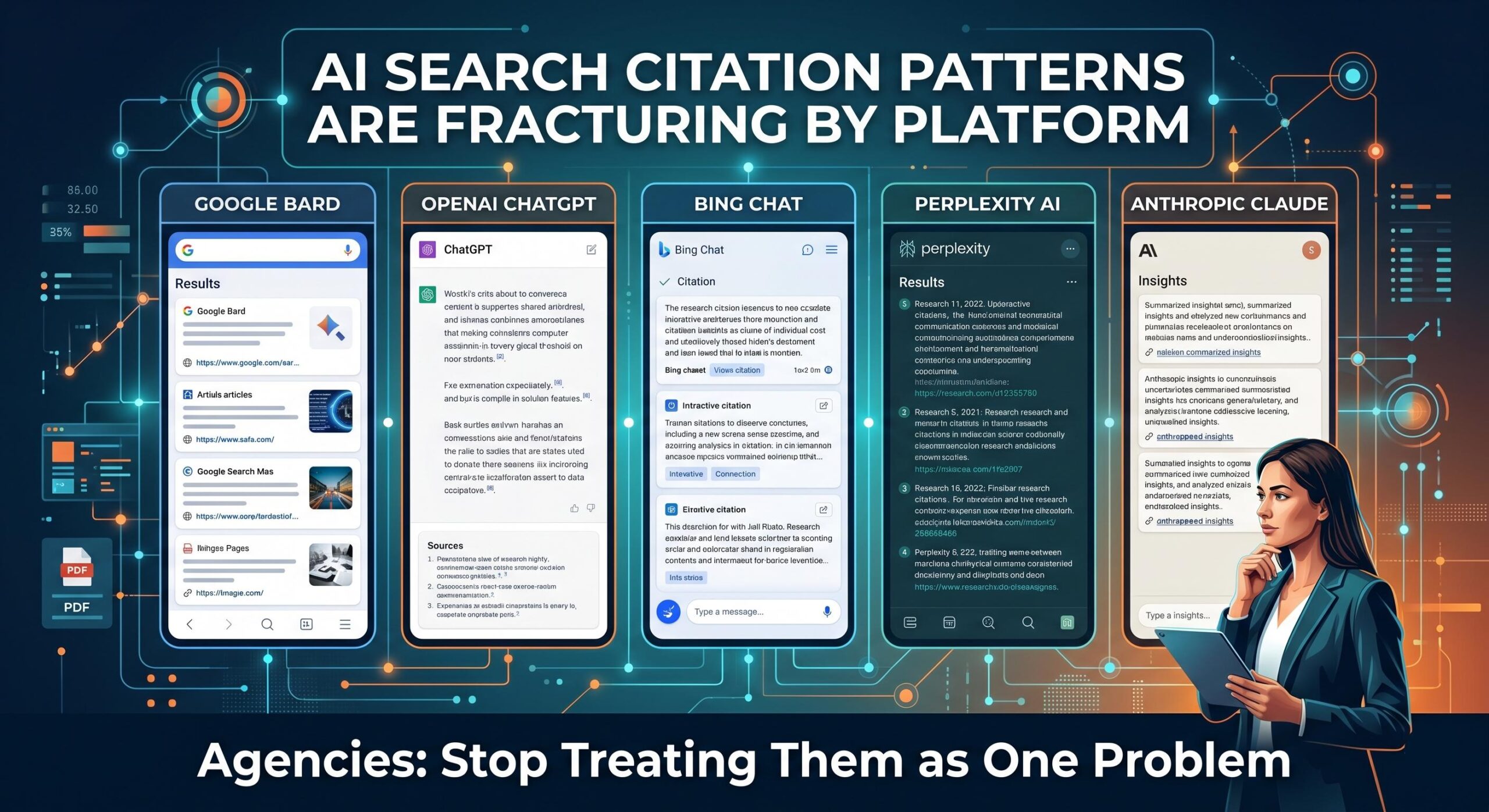
AI Search Citation Patterns Are Fracturing by Platform — and Agencies Need to Stop Treating Them as One Problem
AI search citation patterns are diverging sharply across platforms in 2026, and the agencies still treating generative engine optimisation as a single unified discipline are already falling behind. The data published across Q1 and Q2 this year makes one thing…
AEO and GEO Are Now Core Agency Practice — The Data Makes the Case
AEO and GEO are no longer fringe disciplines debated at conferences — they are now the operational centre of how serious agencies approach brand discovery in AI search. The numbers behind that shift are no longer soft or directional. They are concrete, and they are…
Frequently asked questions
What is AI Search Intel?
AI Search Intel covers the evolving behaviour of AI answer engines — how ChatGPT, Perplexity, Claude, and Gemini select and cite sources, what changes with major model updates, and what data agencies need to track to maintain client visibility across these platforms.
How often do AI search engines change their citation behaviour?
Major model updates — which happen several times per year across the four main engines — can shift citation patterns significantly within days of release. Perplexity updates its retrieval behaviour most frequently. Agencies should run a citation audit within two weeks of any major model release to catch client-level shifts before they compound.
Is Google AI Overviews the same as conversational AI search?
No. Google AI Overviews sit inside Google Search and draw from pages Google has already indexed and ranked. Conversational AI engines — ChatGPT, Perplexity, Claude, Gemini — operate outside Google’s index entirely and use different citation signals. A brand can perform well in AI Overviews and be invisible in conversational AI answers at the same time. Both require separate monitoring and separate strategy.
Which AI search engine should agencies prioritise?
All four matter, but priority depends on where a client’s target audience is most active. Perplexity is growing fastest in research and commercial queries. ChatGPT handles the broadest query volume. Gemini is tightening integration with Google’s knowledge graph. Claude weights editorial corroboration heavily. Run the baseline audit across all four before deciding where to focus remediation effort.
How do agencies monitor AI search behaviour at scale?
Through a structured query sampling methodology — a fixed set of relevant queries run across all four engines on a regular cadence, recording citation presence, accuracy, and competitive share of voice. Legacy SEO tools produce no signal on AI citation behaviour. Purpose-built tracking or a consistent manual sampling process is required.