Your client’s brand can now be defamed at scale by an AI answer engine — and the company running that engine may be legally responsible for it. That is the practical consequence of a landmark ruling handed down in Munich on 9 June 2026, and it reframes what generative engine optimisation is actually protecting against.
Key Takeaways
- The Regional Court of Munich issued a temporary injunction finding Google directly liable for false claims made by its AI Overviews — treating AI-generated summaries as Google’s own authored statements, not protected search results.
- The court ruled that AI Overviews produce “independent, new, and substantive statements” that go beyond the linked source material, stripping Google of the liability shield that has historically protected traditional search engines.
- Google confirmed on 12 June 2026 that it will appeal the ruling, calling the errors “specific and narrow” — but the injunction stands while the appeal proceeds.
- The ruling arrives as the EU AI Act’s transparency obligations for user-facing AI systems take effect on 2 August 2026, compounding the legal pressure on AI answer engines operating in Europe.
- The decision has potential reach beyond Google: legal analysts note it could apply to any AI answer engine — ChatGPT, Claude, Perplexity — that synthesises claims not present in its cited sources.
- For agencies, the ruling adds a brand-safety dimension to AI visibility work that most current retainers do not cover.
What the Munich Court Actually Decided
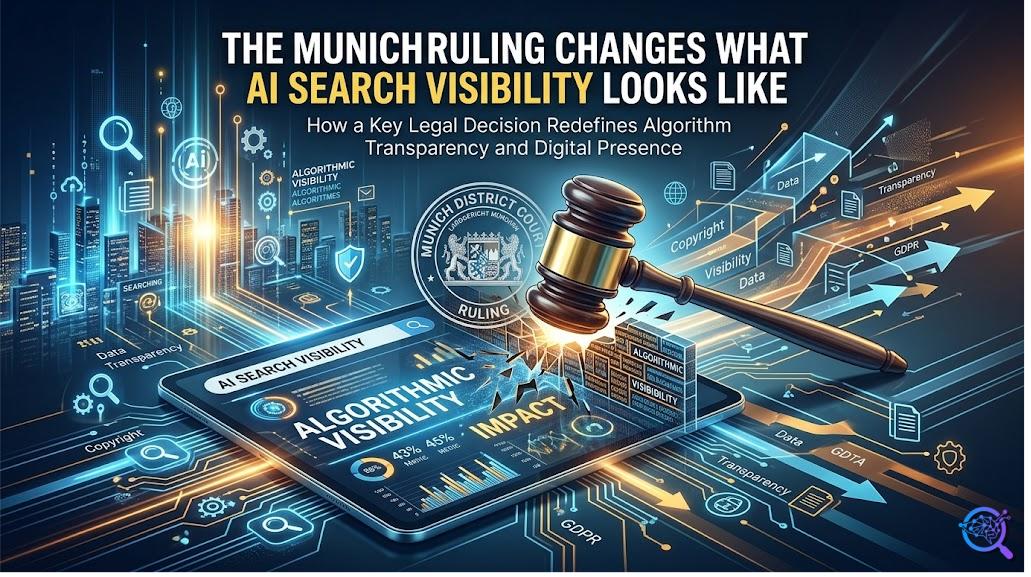
The ruling is not about AI search in the abstract. It is about a specific, verifiable harm: two Munich-based publishers discovered that Google’s AI Overviews had wrongly linked their names to scams, subscription traps, and dubious business practices. The Regional Court of Munich issued a temporary injunction barring Google from repeating false statements about the two publishers, whose names its AI Overviews had wrongly tied to scams, subscription traps, and “dubious business practices” — connections the AI had invented that appeared in none of the linked sources.
The legal argument that makes this consequential is the distinction the court drew between traditional search and AI-generated answers. In its preliminary injunction, the Munich court found that AI Overviews produce “independent, new, and substantive statements” that count as Google’s own content, rather than the neutral list of links a traditional search engine returns — and that distinction is the whole case, because search results have long enjoyed broad legal protection on the basis that the engine is merely pointing to someone else’s words.
The court examined existing rulings from Germany’s Federal Court of Justice, which had given traditional search engines and autocomplete limited liability on the grounds that search engine operators were only indirect infringers because they merely made third-party content findable, and that a proactive duty to check results would threaten how search engines work — but the Munich court found that this reasoning does not apply to AI Overviews.
Google’s defence — that users can click through to verify — was explicitly rejected. Google argued users could check linked sources themselves and that people generally know AI-generated information should not be trusted blindly; the court rejected that defence, finding that the ability to disprove a statement through further research does not normally remove liability for making the statement.
Google said it will appeal the ruling; the company confirmed the appeal on 12 June 2026, after the Regional Court of Munich classified Google as a direct infringer for AI-generated summaries that wrongly tied two publishing companies to scams, dubious business practices, and subscription traps.
The Accuracy Problem the Ruling Puts in Plain Sight
The Munich case is not an edge case about a rogue output. It reflects a structural accuracy gap that independent analysis has already documented. An analysis by AI startup Oumi for the New York Times found that Google’s AI Overviews with the current Gemini 3 model answered correctly 91 percent of the time — solid enough for everyday use by most people, but at Google’s scale it still means millions of wrong answers every hour. More troubling for brands: the Oumi analysis also found that 56 percent of the correct Gemini 3 answers could not be backed up by the sources Google linked, meaning the AI is giving answers whose origins users cannot trace.
That source-answer gap is precisely what the Munich court targeted. The Munich court found that AI Overviews results go further than traditional search because they evaluate, combine, rewrite, and structure information into new statements. When the synthesised output diverges from the underlying sources, the operator — not the source — is now on the hook, at least under German law.
The Broader Legal Pressure Building Around AI Answers
The Munich ruling did not arrive in isolation. The EU AI Act’s transparency obligations for systems that interact with users take effect 2 August 2026, and in the UK, Google is rolling out an AI Overviews opt-out under a binding order from the Competition and Markets Authority. The regulatory environment around AI-generated answers is tightening on multiple fronts simultaneously.
The liability question is also live in the United States, where the legal framework is different but the underlying harm is identical. Parallel battles are unfolding in the United States, where the legal question remains wide open — Minnesota solar installer Wolf River Electric is suing Google after an AI Overview falsely claimed the company was being sued by the state attorney general over deceptive sales practices.
And the potential reach extends well beyond Google. If enough wrong content defames companies or individuals at scale, it could become a serious legal problem not just for Google but for other providers of similar services like ChatGPT, Claude, or Perplexity. The Munich court’s logic — that synthesising third-party content into a new, authoritative-sounding statement creates publisher-level responsibility — applies to any answer engine that does the same thing.
What This Means for Agencies Managing AI Visibility
Most agency retainers in 2026 are built around getting clients into AI answers. The Munich ruling introduces a second, equally urgent problem: what happens when AI answers say something false about your client — and the client has no idea it is happening.
What we see consistently across agency audits is that brands have almost no systematic visibility into what AI engines are saying about them. They check rankings. They do not sample AI answers at scale, across engines, on a regular cadence. That gap is no longer just a missed opportunity — it is a brand-safety exposure.
The cross-engine complexity makes this genuinely hard to manage manually. An analysis of 680 million citations across ChatGPT, Google AI Overviews, and Perplexity reveals that only 11% of domains are cited by both ChatGPT and Perplexity — each platform operates on fundamentally different citation logic. That same divergence means a false or damaging claim can appear on one engine while being entirely absent from another. Spot-checking one platform tells you almost nothing about the others.
The pattern that keeps showing up is this: agencies are tracking share of voice in AI answers for their clients’ target keywords, but nobody is running the inverse query — asking AI engines what they say about the client brand directly, across all four major conversational engines, on a repeating schedule. That is the monitoring gap the Munich ruling makes urgent. Platforms like AI citation and share-of-voice tracking tools exist precisely to surface this kind of cross-engine brand exposure before a client finds out about it from their legal team.
What Schema Markup Actually Does and Does Not Cover
Structured data and schema markup help AI engines parse and extract your own content accurately — Google Search Central’s structured data documentation confirms that FAQPage and other markup improves machine readability — but schema cannot prevent an AI from synthesising claims about your brand from third-party sources you do not control. It is a necessary foundation for AI visibility, not a brand-safety shield against hallucination or misattribution. Agencies that present schema work as a solution to the Munich problem are solving the wrong thing.
The assumption that strong organic rankings protect a client’s AI Overview accuracy is also breaking down faster than most agencies realise. In mid-2025, 76% of AI Overview citations came from top-10 organic results. By early 2026, that figure had dropped to 38% in Ahrefs data and as low as 17% in BrightEdge research. The AI is increasingly drawing from sources outside the organic top ten — sources the agency is not monitoring and the client does not control. A first-page ranking is no longer a reliable proxy for what the AI says about a brand.
The most dangerous misconception is treating this as a European legal problem rather than an immediate client problem. The reputational harm happens the moment a user reads a false AI summary, regardless of which jurisdiction eventually adjudicates the claim. A US-based client whose AI Overview wrongly associates them with fraud has a brand problem today — not after a court ruling next year. The Munich ruling is the legal precedent. The brand exposure it describes is already live everywhere.
What Agencies Should Do Now
Two things are worth acting on immediately, before this ruling either widens or gets replicated in other jurisdictions.
First, run a brand-safety audit across the four major conversational answer engines — ChatGPT, Perplexity, Claude, and Gemini — for your top clients. Query the brand name directly, query it in the context of their category, and query it alongside competitor names. Document what the engines say. You are looking for fabricated associations, incorrect attributions, and claims that do not appear in any source the engine cites. This is not a one-time exercise; it needs to be on a repeating cadence, because AI answers are not static.
Second, brief your clients on the exposure. Most marketing teams are not aware that AI engines can generate false statements about their brand that are legally distinct from anything they published. The Munich ruling gives you a concrete, credible hook for that conversation — and it positions your agency as the team that caught this before it became a crisis.
The Munich ruling is a temporary injunction, not settled law. The Munich order is a temporary injunction, not the final word on AI search liability; Google said it is reviewing the decision, and the ruling may still be challenged. But the underlying problem it exposes — AI engines generating authoritative-sounding claims that are not grounded in their cited sources — is not going away on appeal. The legal outcome is uncertain. The brand risk is not.
Agencies that add systematic AI answer monitoring to their service offering now are not chasing a trend. They are closing a gap that the Munich ruling just made impossible to ignore. Run a free AI visibility audit to see what the four major answer engines are currently saying about your clients’ brands.
Sources:
Regional Court of Munich preliminary injunction, 9 June 2026; Oumi analysis via New York Times; Ahrefs AI Overviews citation research, early 2026; BrightEdge AI search citation data, 2026; Competition and Markets Authority Google AI Overviews order, UK.
Frequently Asked Questions
What did the Munich court actually rule about Google AI Overviews?
The Regional Court of Munich issued a temporary injunction on 9 June 2026 finding Google directly liable for false claims in its AI Overviews. The court ruled that AI-generated summaries are Google’s own authored statements — not protected search results — because they synthesise and rewrite source material into new claims that may not appear in any linked source.
Does the Munich ruling apply to ChatGPT, Claude, and Perplexity as well?
Not directly — the injunction targets Google. But legal analysts note the court’s reasoning applies to any AI answer engine that synthesises third-party content into new, authoritative-sounding statements. If those statements are false and defamatory, the Munich logic would hold the operator liable, not just the source.
How should agencies respond to the AI brand-safety risk the ruling highlights?
Agencies should run systematic brand-safety audits across ChatGPT, Perplexity, Claude, and Gemini — querying client brand names directly and in category context — on a repeating schedule. Because each engine uses different citation logic, a false claim can appear on one platform while being absent from others, making cross-engine monitoring essential.
Will structured data or schema markup protect a brand from false AI claims?
Schema markup helps AI engines parse and extract your own content accurately, but it cannot prevent an AI from synthesising false claims about your brand from third-party sources you do not control. It is a necessary foundation for AI visibility, not a brand-safety shield against AI hallucination or misattribution.