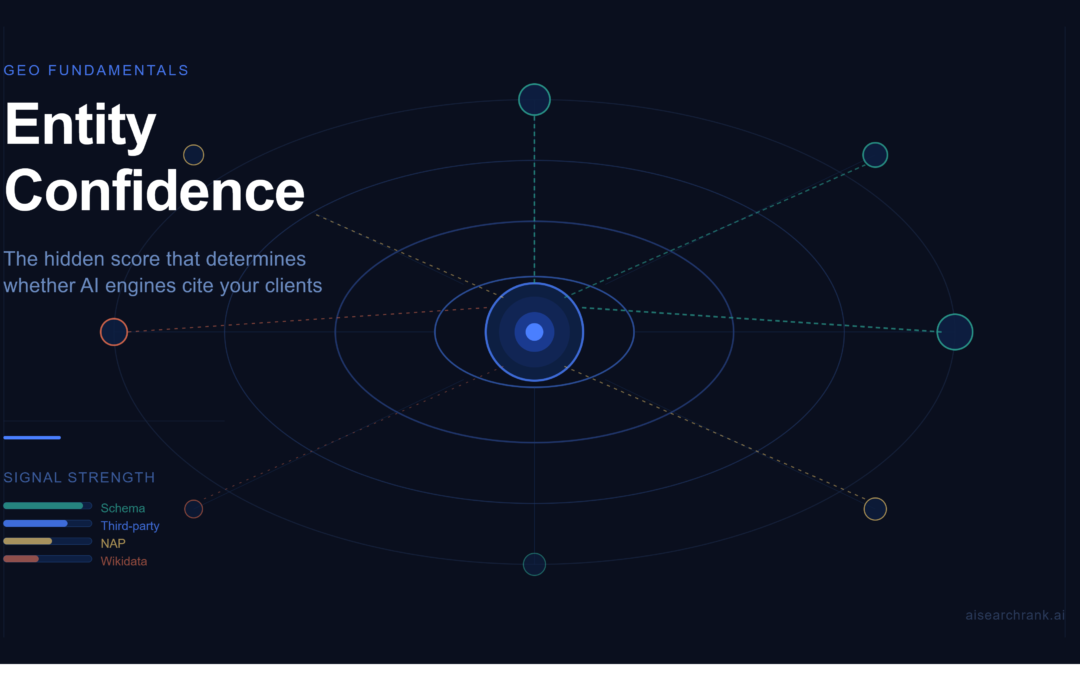
AI engines do not operate with a binary switch — cited or not cited. They hold a continuous, probabilistic assessment of how well they understand a brand: what it does, who it serves, where it operates, and whether third-party sources corroborate that picture. Call this entity confidence — the degree to which an AI engine can resolve a brand into a coherent, trustworthy entity rather than a vague or contradictory cluster of signals. Brands with high entity confidence get cited. Brands with low entity confidence get ignored, misrepresented, or displaced by a competitor the engine understands better.
Key Takeaways
- Entity confidence is the degree to which an AI engine can resolve a brand into a coherent, well-corroborated entity — it is a conceptual model, not a metric any engine publishes, but it maps directly to observable citation behaviour.
- The five primary signals that raise entity confidence are: schema markup consistency, NAP (name, address, phone) accuracy across directories, Wikidata presence, third-party publication mentions, and structured on-site content that answers questions directly.
- Conflicting signals — a brand name spelled differently across directories, schema that contradicts the homepage copy, or a Wikidata entry that disagrees with the website — actively lower entity confidence and suppress citation.
- Entity confidence is not a one-time fix. AI engines re-sample the web continuously, so a signal that is clean today can degrade if a directory listing goes stale or a publication removes a mention.
- Agencies managing AI visibility across multiple clients need a systematic way to audit entity signals per client — the diagnostic complexity scales faster than most teams expect.
- Fixing schema before establishing third-party corroboration is the wrong order. On-site signals alone are insufficient; AI engines weight external, independent sources heavily when resolving entity identity.
Why “Does the AI Know My Client?” Is the Wrong Question
The right question is not whether an AI engine has encountered a brand — it almost certainly has, in some form. The right question is how confidently the engine can characterise that brand when a user asks a relevant question. Low entity confidence produces one of three failure modes: the brand is omitted entirely; it is mentioned but described inaccurately; or it is conflated with a similarly named competitor. All three outcomes are commercially damaging, and none of them show up in a traditional SEO report.
What we see consistently across agency audits is that brands assume their AI visibility problem is a content problem — they need more blog posts, more keywords, more pages. In most cases, the real problem is an entity problem. The AI engine has encountered the brand across dozens of sources, but those sources contradict each other enough that the engine defaults to low confidence and routes its citation to a brand it can resolve cleanly.
What Entity Confidence Actually Measures
Entity confidence is the aggregate coherence of all signals an AI engine can find about a brand, weighted by the authority and independence of the sources carrying those signals. Think of it as the engine asking five questions simultaneously:
- Is the brand’s identity consistent? Does the name, description, category, and location match across the website, schema markup, Google Business Profile, Yelp, industry directories, and Wikidata?
- Do independent sources corroborate the brand’s claims? Have credible third parties — trade publications, news outlets, review platforms, professional associations — described the brand in terms that align with how the brand describes itself?
- Is the brand’s content structured for extraction? Can the engine lift a direct, coherent answer from the brand’s own pages, or does it have to infer meaning from buried, discursive prose?
- Is the brand’s entity record complete? Does a Wikidata entry exist? Is the schema markup present and internally consistent? Are the structured data types (Organisation, LocalBusiness, Product, FAQPage) correctly implemented and aligned with what the page actually says?
- Are the signals stable over time? A brand whose signals have been consistent for years carries more confidence weight than one whose directory listings were cleaned up last month.
No engine publishes a score. But the pattern of citation behaviour — which brands get named, how accurately, and in response to which queries — reflects this underlying confidence calculation directly.
The Five Signals That Raise Entity Confidence
1. Schema Markup Consistency
Schema markup is the most direct signal an AI engine can read about a brand’s identity, but only when it is consistent with the surrounding page content. An Organisation schema block that names the brand one way while the homepage H1 uses a different variant creates a contradiction the engine must resolve — and when in doubt, it discounts both. The fix is not just adding schema; it is auditing every schema type on every key page and confirming that the name, URL, description, and contact details match exactly. Google Search Central’s structured data documentation makes clear that markup must reflect visible page content — a principle AI engines have absorbed into their own parsing behaviour.
2. NAP Accuracy Across Directories
Name, address, and phone number (NAP) consistency is the oldest signal in local SEO, but its role in entity confidence for AI search is underappreciated. AI engines pull from aggregated web data that includes directory listings, citation databases, and map platforms. A brand whose phone number appears in three different formats, or whose address was updated on the website but not in forty directory listings, presents a fragmented identity. The engine cannot confidently resolve which version is canonical, so it hedges — or cites a competitor whose NAP record is clean.
3. Wikidata Presence
Wikidata is the structured knowledge base that feeds Wikipedia’s infoboxes and, more importantly, provides a machine-readable entity record that AI engines treat as a high-authority reference point. A brand with a well-maintained Wikidata entry — correctly categorised, linked to its official website, and cross-referenced with relevant industry classifications — gives AI engines a canonical anchor for entity resolution. A brand without one forces the engine to infer identity from less structured sources, which introduces noise and lowers confidence. For most mid-market brands, creating and maintaining a Wikidata entry is a low-effort, high-impact intervention that agencies routinely overlook.
4. Third-Party Publication Mentions
This is the signal that matters most and is the hardest to manufacture. When credible, independent sources — trade publications, regional news outlets, industry associations, professional review platforms — describe a brand in terms consistent with how the brand describes itself, entity confidence rises sharply. The independence is what matters: an AI engine weights a mention in a respected trade journal far more heavily than a press release republished verbatim across wire services. Generative engine optimisation services are largely about earning exactly these mentions — structured outreach that places the brand in credible third-party contexts, not just on its own properties.
5. Answer-First On-Site Content
Even with strong off-site signals, an AI engine still needs to be able to extract a coherent answer from the brand’s own pages. Content that buries its point in discursive prose — that takes three paragraphs to arrive at a direct answer — is harder for an engine to lift and attribute confidently. Structured content that leads with a direct answer, uses descriptive headings, and organises information in a way that mirrors how questions are asked raises the extractability of the brand’s own voice. This is the on-site, extraction-focused work that answer engine optimisation addresses directly.
Worked Example: Before and After Entity-Confident Content
Consider a mid-sized accountancy firm trying to appear in AI answers to the query “best accountants for e-commerce businesses in Manchester”. Here is how their current “About” page reads:
Before: “At Hartley & Co, we have been serving businesses across the North West for over two decades. Our team of experienced professionals brings a wealth of knowledge to every engagement, working collaboratively with clients to understand their unique needs and deliver tailored financial solutions across a range of sectors.”
An AI engine reading this cannot confidently resolve: what type of accountancy the firm specialises in, whether e-commerce is a served sector, or what distinguishes the firm from any other North West practice. Entity confidence from this passage: low. Now consider a rewrite structured for extraction:
After: “Hartley & Co is a Manchester-based chartered accountancy firm specialising in tax, VAT compliance, and financial reporting for e-commerce businesses. Founded in 2003, the firm serves online retailers across the UK, with particular expertise in multi-channel VAT obligations and platform-specific revenue recognition.”
The second version gives an AI engine a direct, attributable answer to the query. It names the location, the specialism, the client type, and a differentiating detail — all in two sentences. An engine can lift this verbatim and cite it with confidence. The first version forces the engine to infer, and when inference is required, a brand with cleaner signals wins the citation.
Common Misconceptions About Entity Confidence
Myth: Adding schema markup is sufficient. Reality: Schema is a necessary signal, but it is one input into a multi-source confidence calculation. An engine that finds clean schema on the website but contradictory information in directories and no third-party corroboration will still assign low confidence. Schema is the floor, not the ceiling.
Myth: A Wikipedia article guarantees citation. Reality: Wikipedia helps, but AI engines are not simply reading Wikipedia. They are resolving entities across the full web graph. A Wikipedia article that contradicts the brand’s current positioning — because it was written years ago and never updated — can actually introduce a confidence-lowering inconsistency.
Myth: More content means more citations. Reality: Volume of content is not a confidence signal. An AI engine that finds fifty blog posts, none of which are structured for extraction and none of which are cited by independent sources, learns very little about the brand’s entity. The pattern that keeps showing up in audits is brands with extensive content libraries and near-zero AI citation — because the content is written for human readers browsing a website, not for engines resolving an entity.
These misconceptions persist partly because the tactics that address them — directory audits, Wikidata maintenance, structured third-party outreach — are harder to bill and report on than content production. Legacy tooling built for blue-link SEO cannot see AI citation behaviour at all, so agencies default to what their dashboards can measure. That is an incentive problem as much as a knowledge problem.
The Diagnostic Challenge Agencies Actually Face
Auditing entity confidence for a single brand is already complex: it requires sampling queries across ChatGPT, Perplexity, Claude, and Gemini; comparing citation frequency against competitors; cross-referencing schema markup against directory listings; checking Wikidata completeness; and reviewing the quality and recency of third-party mentions. Do this for a roster of twenty clients and the complexity does not scale linearly — it compounds. Each client has a different entity baseline, different competitive set, and different mix of signal gaps. AI citation and share-of-voice tracking across engines is the only way to see which clients are gaining or losing ground and why, rather than guessing from anecdotal spot-checks.
The diagnostic work also never ends. AI engines re-index the web continuously. A directory listing that goes stale, a publication that removes a mention, or a competitor that earns a new wave of press coverage can shift the confidence calculation within weeks. Entity confidence is a maintenance discipline, not a one-time audit.
The Right Order of Operations
The single most common mistake agencies make when starting entity work is fixing schema first and treating third-party citation as a later phase. This is the wrong order. On-site schema signals are processed in the context of what independent sources say about the brand. A brand with perfect schema and no third-party corroboration is a brand making unverified claims about itself — and AI engines, trained on the full web, are calibrated to discount exactly that. The correct sequence is: establish or clean the Wikidata entry, audit and correct NAP consistency across directories, pursue credible third-party mentions through structured outreach, and then layer schema and on-site content restructuring on top of that external foundation. Schema amplifies entity confidence that already exists; it cannot create it from nothing.
Entity confidence is the lens through which AI engines decide whether your clients are worth citing. Brands that understand this — and agencies that can diagnose and improve it systematically — will hold AI visibility as a durable competitive position. Brands that keep producing content without addressing the underlying entity signals will keep wondering why the AI never mentions them. If you want to see where a client’s entity signals actually stand across ChatGPT, Perplexity, Claude, and Gemini, start with a free AI visibility audit — it surfaces the citation gaps and entity inconsistencies that most teams have never measured.
Frequently Asked Questions
What is entity confidence in AI search?
Entity confidence is the degree to which an AI engine can resolve a brand into a coherent, well-corroborated identity — understanding what it does, who it serves, and whether independent sources agree. Higher entity confidence means the engine is more likely to cite the brand accurately in response to relevant queries.
What signals raise entity confidence for a brand?
The five primary signals are: consistent schema markup that matches visible page content, accurate NAP (name, address, phone) data across directories, a complete Wikidata entry, credible third-party publication mentions, and on-site content structured to deliver direct, extractable answers. All five must be aligned — gaps in any one signal lower overall confidence.
Does adding schema markup guarantee AI citation?
No. Schema markup is a necessary signal but not sufficient on its own. AI engines assess entity confidence across multiple independent sources. A brand with clean schema but contradictory directory listings or no third-party mentions will still receive low confidence scores and be passed over in favour of a brand whose signals are coherent across the full web.
Why does Wikidata matter for AI visibility?
Wikidata provides a machine-readable, structured entity record that AI engines treat as a high-authority reference point for identity resolution. A well-maintained Wikidata entry — correctly categorised and linked to the brand’s official website — gives engines a canonical anchor, reducing ambiguity and raising entity confidence measurably.
How often do entity signals need to be maintained?
Continuously. AI engines re-sample the web on an ongoing basis, so a directory listing that goes stale, a publication that removes a mention, or a competitor earning new press coverage can shift citation behaviour within weeks. Entity confidence is a maintenance discipline, not a one-time audit or a project with a defined end date.
What is the correct order of operations for improving entity confidence?
Start with Wikidata and NAP consistency, then earn credible third-party mentions through structured outreach, then layer schema markup and on-site content restructuring on top. Schema amplifies existing entity confidence — it cannot substitute for the external corroboration that AI engines weight most heavily when resolving brand identity.