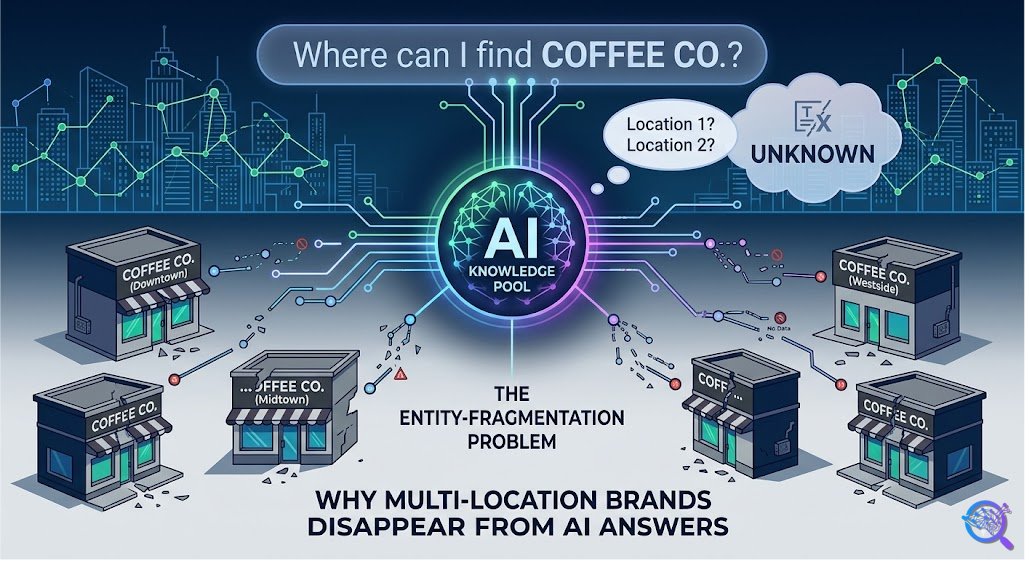
Multi-location brands disappear from AI answers not because they lack content, but because fragmented entity signals — inconsistent names, addresses, phone numbers, and schema across dozens of locations — cause AI engines to treat each location as a separate, low-authority entity rather than recognising a single, coherent brand. The fix is not more content; it is entity consolidation.
Key Takeaways
- Entity fragmentation occurs when a multi-location brand's name, address, phone number, and schema markup are inconsistent across locations, causing AI engines to see many weak, disconnected entities instead of one authoritative brand.
- AI engines — ChatGPT, Perplexity, Claude, and Gemini — build their understanding of a brand from third-party sources, structured data, and the consistency of signals across the web; inconsistency actively suppresses citation.
- The most common fragmentation triggers are NAP (name, address, phone) inconsistency, duplicate or missing Google Business Profiles, conflicting schema markup across location pages, and thin or absent Wikidata presence.
- Fixing entity fragmentation requires a structured audit across all locations before any content or link-building work — remediation done in the wrong order wastes budget and delays results.
- Agencies managing multi-location clients face this problem at scale: a single franchise with 40 locations can have hundreds of conflicting signals, each one quietly eroding the brand's AI visibility.
- A consolidated, answer-first content structure on each location page — combined with clean schema and consistent NAP — is the minimum viable signal set for AI citation at the location level.
What Entity Fragmentation Actually Means for AI Engines
Entity fragmentation is the condition in which a brand's identity signals are inconsistent enough across the web that AI language models cannot confidently resolve them to a single, trustworthy entity. AI engines do not crawl the web the way a search bot does. They build a probabilistic understanding of who a brand is from the aggregate of third-party mentions, structured data, Knowledge Panel signals, and the consistency of NAP data across directories, review platforms, and the brand's own pages. When those signals conflict — "Maple Dental" in one directory, "Maple Dental Clinic" in another, "Maple Dental Care" on the website, with three different phone numbers across ten locations — the model's confidence in the brand collapses. It either cites a competitor it can resolve cleanly, or it cites no one.
This is the mechanism agencies need to understand and explain to clients. It is not an algorithm penalty. It is a confidence problem. AI engines are, at their core, pattern-recognition systems trained to surface entities they can verify. Fragmentation makes verification impossible.
Why Multi-Location Brands Are Especially Vulnerable
Multi-location brands are structurally more exposed to entity fragmentation than single-location businesses because every location is a potential source of conflicting signals. A regional restaurant group with 25 locations has 25 Google Business Profiles, 25 sets of directory listings, 25 location pages on the website, and potentially 25 different managers who have, at some point, updated something independently. Each inconsistency compounds the others.
The problem is further amplified by how these brands typically grew. Acquisitions, franchise agreements, and regional rebrands leave a trail of legacy names and addresses that persist in directories for years. A brand that acquired three smaller chains five years ago may still have the acquired names appearing in AI answers — not because the AI is wrong, but because the web still says those names are associated with those addresses. The AI is faithfully reflecting a fragmented reality.
Franchise networks face a specific variant of this problem: franchisees who customise their own listings, add local phone numbers, or create independent social profiles generate signals that contradict the franchisor's canonical data. From an AI engine's perspective, these look like separate, competing entities — and the brand's share of voice in AI answers fractures accordingly.
The Four Fragmentation Triggers Agencies Should Audit First
In practice, entity fragmentation in multi-location brands almost always traces back to one or more of four root causes. Audit these before touching content or building citations.
1. NAP Inconsistency Across Directories and Location Pages
Name, address, and phone number inconsistency is the most common and most damaging fragmentation trigger. Even minor variations — "St" versus "Street", a missing suite number, a local versus toll-free number — are enough to prevent AI engines from confidently resolving locations to the parent brand. The audit here is mechanical: pull every directory listing, every location page, and every Google Business Profile and compare them against a canonical NAP record. The gaps will be obvious. The remediation is tedious but not complex.
2. Duplicate or Unclaimed Google Business Profiles
Duplicate GBP listings are a persistent problem for brands that have moved, rebranded, or been acquired. Each duplicate is a competing entity signal. Unclaimed profiles are worse: they accumulate user-generated edits that no one is correcting. AI engines weight Google Business Profile data heavily because it is a high-authority, structured source — a corrupted GBP is a direct line to corrupted AI answers.
3. Conflicting or Absent Schema Markup on Location Pages
Schema markup — specifically LocalBusiness structured data on each location page — is one of the clearest signals an AI engine can use to understand a brand's physical presence. When location pages have no schema, inconsistent schema, or schema that contradicts the NAP data in the body of the page, the structured signal is either absent or actively misleading. Google Search Central's Search Essentials documentation makes clear that structured data must accurately reflect the visible content of the page — a mismatch between schema and on-page content is treated as an error, not a bonus signal.
4. Thin or Absent Wikidata and Knowledge Panel Presence
Wikidata is a primary source for AI language models establishing entity identity. A brand with no Wikidata entry, or a Wikidata entry that lists only the head office and ignores the broader network, is invisible at the entity layer. The Knowledge Panel — which Google surfaces from its Knowledge Graph, itself informed by Wikidata — is one of the clearest signals that a brand is a resolved, authoritative entity. Multi-location brands that have never invested in Wikidata presence are operating without a foundation that AI engines rely on.
Worked Example: Before and After Entity-Fragmented Location Content
The content structure of individual location pages matters as much as the technical signals. Here is a common pattern agencies encounter, and what a corrected version looks like.
Before (buried answer, fragmented signal):
"Welcome to our Oakville location! We are proud to serve the Oakville community with the same great service you have come to expect from us. Our team of experienced professionals is here to help. We offer a wide range of services. Come visit us today at our convenient location. We look forward to seeing you soon."
This paragraph tells an AI engine almost nothing. There is no structured answer to any question a user might ask. The location name, address, services, and hours are absent. An AI engine asked "which physiotherapy clinics are in Oakville?" cannot extract a usable answer from this text, and will not cite this page.
After (answer-first, citable):
"Lakeside Physiotherapy Oakville is located at 214 Lakeshore Road East, Oakville, ON L6J 1H8, and is open Monday through Saturday, 8 a.m. to 6 p.m. The clinic offers sports rehabilitation, post-surgical physiotherapy, and registered massage therapy. Same-week appointments are available by calling (905) 555-0142 or booking online."
This version answers the questions an AI engine is most likely to receive — where is it, what does it offer, how do I book — in the first two sentences. It matches the NAP data in the schema markup and the Google Business Profile. An AI engine can lift this verbatim as a citation. The first version cannot be cited at all.
The principle extends to every location page in the network. Each page should open with a direct, factual answer to the most likely query for that location, not a welcome message.
The Remediation Order That Actually Works
The most common mistake agencies make when fixing entity fragmentation is starting with content or link-building before the entity foundation is clean. Building citations to a fragmented entity does not consolidate it — it amplifies the fragmentation. Third-party sites will pick up the inconsistent signals and propagate them further.
The correct order is: audit first, consolidate the entity layer, then build content and citations on top of a clean foundation. Specifically:
- Establish a canonical NAP record for every location and enforce it across all owned properties.
- Resolve duplicate and unclaimed Google Business Profiles before touching anything else.
- Audit and correct schema markup on every location page so it matches the canonical NAP exactly.
- Create or correct Wikidata entries for the parent brand and, where warranted, major locations.
- Only then begin structured content improvements — answer-first location pages, FAQPage markup (described in plain terms: each question and its answer should be marked up so AI engines can extract them as discrete units), and service-level content.
- Build third-party citations and off-site authority last, once the entity the citations point to is clean and resolvable.
This sequence is not intuitive for agencies whose instinct is to start with content because content is billable and visible. Entity consolidation is unglamorous. But skipping it means the content work is built on a broken foundation, and the AI visibility gains will be partial and unstable.
Common Misconceptions About Entity Fragmentation
Myth: More location pages means more AI visibility. Reality: Thin, duplicate, or inconsistent location pages actively harm entity resolution. Ten well-structured location pages outperform a hundred weak ones every time.
Myth: Fixing the website is enough. Reality: AI engines draw from the entire web, not just the brand's own site. Directory listings, review platforms, and third-party mentions all contribute to entity resolution. On-site fixes without off-site cleanup leave the fragmentation intact.
Myth: Schema markup alone will fix it. Reality: Schema is a necessary signal, but it only helps if it is consistent with the NAP data everywhere else. Schema that contradicts directory listings or GBP data adds a conflicting signal rather than resolving one.
Myth: This is a one-time fix. Reality: Entity fragmentation recurs. Franchisees update listings. Staff change phone numbers. Directories auto-populate from stale sources. Maintaining entity health for a multi-location brand is an ongoing operational task, not a project with an end date.
These misconceptions persist partly because the tactics that do not work — more pages, more schema, more content — are easy to sell and easy to report on. The work that actually fixes entity fragmentation is harder to package as a deliverable, which is why it keeps getting skipped.
What Agencies Need to Track After Remediation
Fixing entity fragmentation is not the end of the engagement — it is the beginning of a measurable one. Once the entity layer is clean, agencies need to track whether AI engines are actually resolving the brand correctly and citing individual locations in relevant answers. This means sampling queries across ChatGPT, Perplexity, Claude, and Gemini — not once, but repeatedly over time, because AI answers shift as models update and as competitor signals change.
The diagnostic work here is genuinely complex. It requires running location-specific queries across multiple engines, comparing citation rates against competitors, and identifying which locations are still being missed or misattributed. A spreadsheet and an afternoon will not cover it for a client with 30 locations. AI citation and share-of-voice tracking at this scale requires tooling built for the purpose — the kind that can surface which locations are cited, which are invisible, and which are being displaced by a competitor who has cleaner entity signals.
Entity fragmentation is the most underdiagnosed reason multi-location brands fail to appear in AI answers, and it is the one problem that content and link-building cannot compensate for. The brands that will hold share of voice in AI answers over the next few years are the ones whose entity signals are clean, consistent, and resolvable — not the ones with the most pages. If you manage multi-location clients and have not audited their entity layer, start there. Run a free AI visibility audit to see which of your clients' locations are being cited, which are invisible, and where the fragmentation is worst — then you will know exactly where to focus the remediation work.
Frequently Asked Questions
What is entity fragmentation in AI search?
Entity fragmentation occurs when a brand's name, address, phone number, and structured data signals are inconsistent across directories, location pages, and third-party sources. AI engines cannot confidently resolve the brand as a single entity, so they either cite a competitor or omit the brand entirely from their answers.
Why do multi-location brands disappear from AI answers more than single-location businesses?
Multi-location brands generate more opportunities for inconsistency — each location has its own listings, schema, and Google Business Profile. Acquisitions, rebrands, and franchisee-managed listings compound the problem. AI engines see many conflicting signals and cannot resolve them to one authoritative brand, suppressing citation across the network.
What is the correct order to fix entity fragmentation for a multi-location client?
Audit and consolidate the entity layer first: establish a canonical NAP record, resolve duplicate Google Business Profiles, correct schema markup, and build Wikidata presence. Only then improve content and build third-party citations. Building citations before the entity is clean amplifies fragmentation rather than fixing it.
Does fixing schema markup on location pages solve entity fragmentation?
Schema markup is a necessary signal but not sufficient on its own. If the schema contradicts NAP data in directories or Google Business Profiles, it adds a conflicting signal rather than resolving the fragmentation. Schema must be consistent with every other entity signal across the web to be effective.
How long does it take to see AI visibility improvements after fixing entity fragmentation?
You will not see movement overnight. In practice, the first citation signals tend to appear within weeks of resolving the most severe NAP and GBP conflicts. Full consolidation across a large location network takes longer — the compounding gains come as third-party sources update and AI models re-index the corrected signals.
How should agencies track entity fragmentation fixes across multiple clients?
Agencies need to sample location-specific queries across ChatGPT, Perplexity, Claude, and Gemini repeatedly over time — not as a one-off audit. Citation rates, share of voice, and competitor displacement must be tracked per location. At scale, this requires dedicated tooling; manual sampling across dozens of locations and four engines is not sustainable.