Industry Data
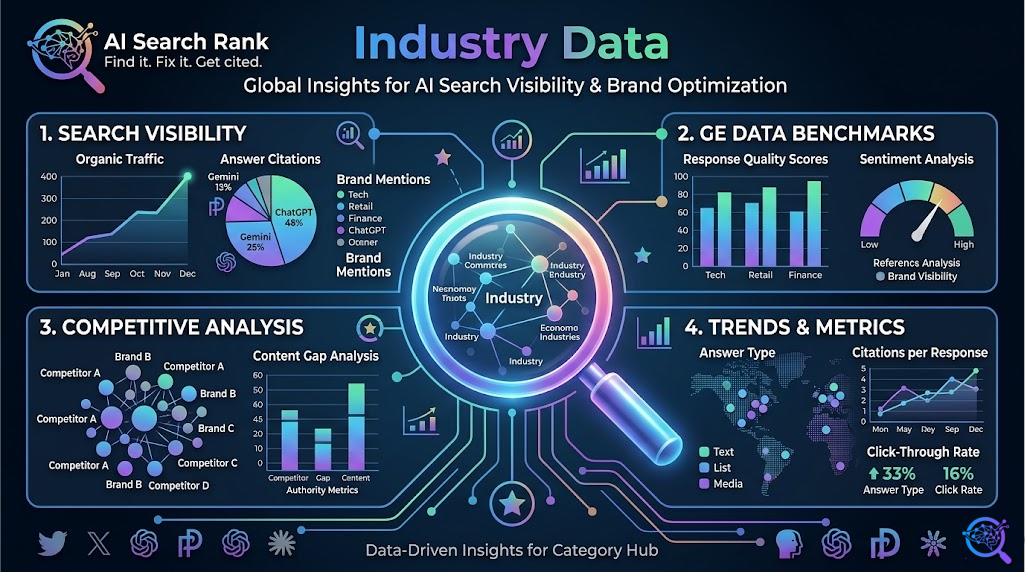
What Industry Data Means for AI Search Visibility
Industry data in the context of AI search is not traffic reports or keyword rankings — it is the quantitative evidence that establishes a brand’s authority within its category. AI engines weight third-party data citations heavily when deciding which sources to trust. A brand referenced in an industry report, cited in a market sizing study, or listed in a credible directory carries more citation weight than a brand that only references its own claims. For agencies, sourcing and placing clients within authoritative industry data sets is one of the highest-leverage activities in a GEO engagement — it simultaneously builds entity corroboration and creates the kind of independent third-party signal that AI engines are specifically looking for.
How AI Engines Use Market Data to Establish Category Authority
When an AI engine receives a query about a market category — “best CRM for small business” or “top GEO platforms for agencies” — it resolves the answer by cross-referencing entity signals across multiple source types: review platforms, directories, trade press, and industry data. Brands that appear in multiple independent data sources for the same category are resolved as authoritative. Brands that appear only on their own website are treated as unverified. The practical implication is that getting a client listed in G2, Capterra, Crunchbase, or a relevant trade association database is not just a citation-building exercise — it is entity resolution work that directly influences whether AI engines include them in category answers.
The Data Sources AI Engines Weight Most Heavily
Not all third-party data sources carry equal weight. Review platforms with structured data — G2, Capterra, Trustpilot — are weighted heavily because they carry independent user signals alongside structured entity information. Industry directories with consistent NAP data and category classification contribute to entity resolution. Analyst reports and market sizing studies from credible research firms create corroboration signals that are difficult to replicate through content alone. Trade press coverage in recognised industry publications — even brief mentions — contributes more citation authority than long-form content on a brand’s own site. For agencies building a client’s AI search presence, the sourcing priority should follow this hierarchy rather than defaulting to content production.
How to Use Industry Benchmarks in Client Reporting
Industry benchmark data serves two functions in a GEO engagement. First, it gives clients a comparative frame for their citation share of voice — knowing that a brand appears in 40% of relevant AI answers means more when the category average is 15% or the leading competitor appears in 70%. Second, benchmark data makes the retainer conversation defensible. Clients who understand where they sit relative to category norms are more likely to invest in the ongoing work required to close the gap. Agencies that can present citation share of voice alongside industry benchmarks — even rough ones derived from sampling competitor citation rates — are better positioned to retain clients through the lag period before remediation work produces visible results.
Emerging Trends in AI Search Behaviour Agencies Need to Track
The AI search landscape is moving fast enough that data from six months ago may no longer reflect current citation mechanics. The trends with the most immediate agency relevance are: the continued growth of Perplexity as a commercial research tool, particularly in B2B categories; the tightening integration between Gemini and Google’s structured data ecosystem, which is increasing the citation weight of Google Business Profile and structured schema; the expansion of ChatGPT’s real-time browsing, which is making recency of third-party coverage more important for brands in fast-moving categories; and the gradual emergence of AI search analytics tooling that will eventually make citation tracking as routine as rank tracking. Agencies that build the measurement infrastructure now will be ahead of the curve when clients start asking for this data as a standard deliverable.
Industry Data
AI engines don’t decide which brands to cite based on who publishes the most content — they decide based on who appears in the most credible independent data sources. Industry Data covers the benchmarks, market research, directory signals, and third-party data sets that establish category authority in AI search, and how agencies can use that evidence to build client visibility and defend retainer relationships with concrete performance data.
How Fast Is AI Search Growing? Usage Stats Every Agency Should Know
Your clients’ customers are already asking ChatGPT, Perplexity, Claude, and Gemini for recommendations — and most agency retainers were scoped before that behaviour existed at scale. AI search growth statistics are no longer a curiosity for forward-looking…
Which Industries Are Getting Cited Most by AI — And Which Are Being Left Behind
AI citation by industry is not evenly distributed — a small cluster of sectors captures the majority of references in ChatGPT, Perplexity, Claude, and Gemini answers, while entire verticals are functionally invisible to the hundreds of millions of people now using AI…
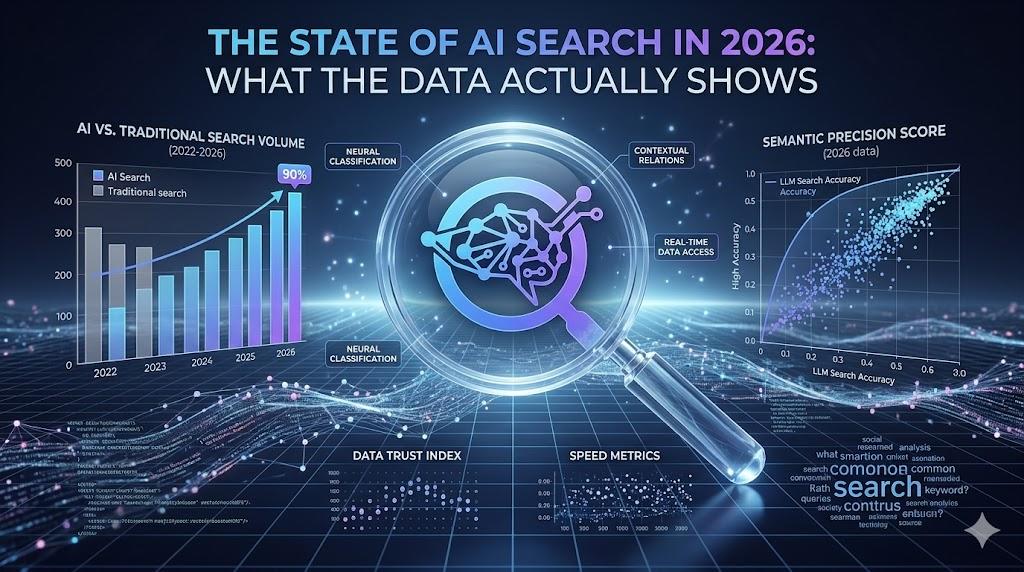
The State of AI Search in 2026: What the Data Actually Shows
AI search is no longer a trend to monitor — it is the primary discovery channel for a large and growing share of commercial queries, and most brands are not in the answers. The AI search statistics 2026 picture is one of rapid, uneven adoption: usage of conversational…
Frequently asked questions
Why does industry data matter for AI search visibility?
AI engines weight third-party data citations heavily when resolving which brands to trust in a category. A brand referenced in an industry report, review platform, or credible directory carries more citation authority than one that only appears on its own website. Sourcing and placing clients within authoritative industry data sets is one of the highest-leverage activities in a GEO engagement.
Which third-party data sources carry the most weight with AI engines?
Review platforms with structured data — G2, Capterra, Trustpilot — carry significant weight because they combine independent user signals with structured entity information. Industry directories with consistent category classification contribute to entity resolution. Analyst reports and trade press coverage in recognised publications create corroboration signals that content production alone cannot replicate.
How do agencies use industry benchmarks in client reporting?
Benchmark data gives clients a comparative frame for their citation share of voice — knowing a brand appears in 40% of relevant AI answers means more when the category average is 15%. It also makes the retainer conversation defensible by showing where a client sits relative to competitors and what closing that gap requires.
What emerging AI search trends should agencies be tracking?
The four trends with the most immediate agency relevance are: Perplexity’s growth in B2B commercial queries, Gemini’s tightening integration with Google’s structured data ecosystem, ChatGPT’s expanding real-time browsing making content recency more important, and the emergence of purpose-built AI search analytics tooling that will make citation tracking a standard client deliverable.
How is AI search data different from traditional SEO data?
Traditional SEO data — rankings, organic traffic, Search Console impressions — produces no signal on AI citation behaviour. AI search performance is measured through citation share of voice: how frequently a brand appears in AI-generated answers to a defined query set, across ChatGPT, Perplexity, Claude, and Gemini, tracked over time against competitors. This requires purpose-built sampling, not legacy tooling.