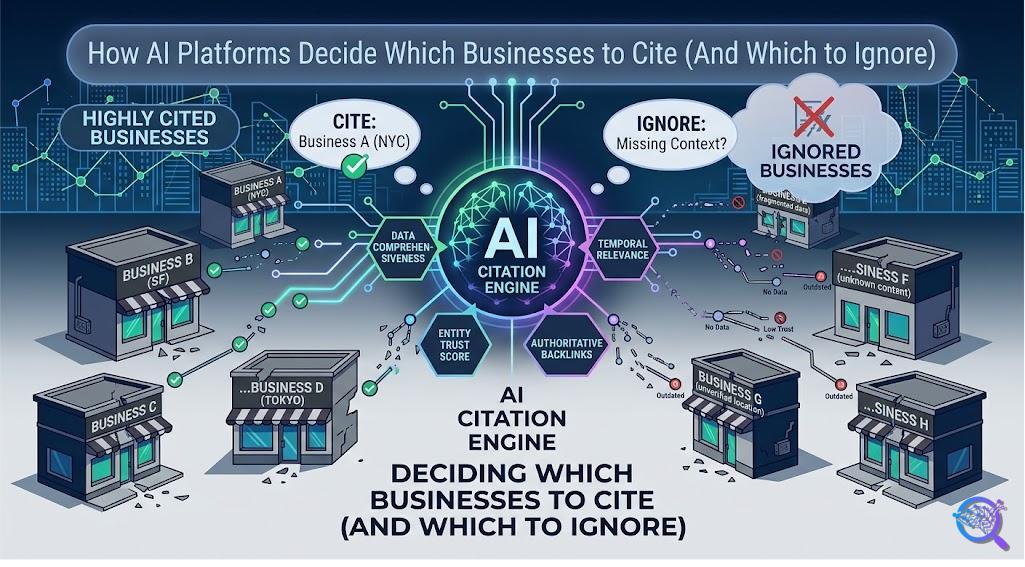
AI platforms cite businesses that have three things in common: a well-defined entity that the model can confidently identify, structured content it can extract a clean answer from, and third-party validation that corroborates the brand's authority in its category. If any one of those three is missing, the business tends to get skipped — not penalised, just ignored.
Key Takeaways
- AI citation decisions are driven by entity clarity, content extractability, and third-party corroboration — not by domain authority or keyword rankings alone.
- A business that is well-known in traditional search can still be invisible in AI answers if its entity signals are weak or its content is structured for humans rather than machines.
- Third-party citations — from industry publications, review platforms, directories, and press coverage — are among the strongest signals that an AI model uses to confirm a brand's relevance and trustworthiness.
- Answer-first content structure (the direct answer in the opening sentence, not buried three paragraphs down) is the single most actionable on-site change most businesses can make.
- Schema markup, particularly FAQPage and Organization types, helps AI systems parse content accurately — but it amplifies good content; it does not rescue thin or ambiguous content.
- Citation patterns shift constantly across ChatGPT, Perplexity, Claude, and Gemini — a brand cited reliably on one engine can be absent on another, which is why tracking across all four matters.
Why This Question Matters More Than It Did Two Years Ago
Your best clients are being recommended — or not recommended — by AI systems dozens of times a day, and neither you nor they have any visibility into it without deliberately looking. The old SEO playbook told you that ranking on page one meant being found. That is no longer the whole story. A business can hold a top-three organic position and still be absent from every AI-generated answer in its category. The selection criteria are different, and understanding them is now a core competency for any agency managing digital visibility.
This is the domain of generative engine optimisation (GEO) — the practice of building a brand's off-site authority, third-party citations, and content footprint so that generative AI systems recommend and cite it. Its on-site counterpart, answer engine optimisation (AEO), focuses on structuring content so AI engines can extract and surface it directly. Both disciplines are now mature enough that the signals driving citation decisions are well understood, even if the models themselves remain opaque.
Signal One: Entity Clarity — Does the Model Know Who You Are?
The first gate a business must pass is entity recognition — the model needs to be able to confidently identify the brand as a distinct, real-world entity with a clear category, location, and purpose.
AI language models are trained on enormous corpora of web text, and they build internal representations of entities — businesses, people, places, concepts — based on how consistently and coherently those entities are described across sources. A business that is described differently on its own website, its Google Business Profile, its Yelp listing, and its LinkedIn page creates a fragmented signal. The model may recognise the name but lack the confidence to assert it as the authoritative answer to a specific query.
The practical fix is NAP consistency (Name, Address, Phone) across every directory and platform, combined with a clear, machine-readable description of what the business does and who it serves. An Organization schema type on the homepage — describing the business in plain prose with consistent naming — helps AI systems parse that identity accurately. Wikidata entries and Knowledge Panel presence further reinforce entity confidence, particularly for brands operating in competitive categories where multiple similar businesses exist.
What we see again and again across agency audits is that entity fragmentation is the silent killer. A business has done everything else right — good content, decent backlinks — but the model hedges because it cannot confidently resolve the entity. The citation goes to a competitor with a cleaner signal.
Signal Two: Content Extractability — Can the Model Lift a Clean Answer?
AI answer engines do not summarise your page the way a human reader would. They look for passages that are already structured as direct answers — a claim followed by supporting detail, or a question followed by a concise response. If the answer to a user's query is buried in the third paragraph of a 900-word blog post, the model will often pass over it in favour of a source that leads with the answer.
This is the most actionable signal for most businesses, and it is where the gap between traditional SEO writing and AI-optimised writing is most visible.
Worked Example: Before and After
Before (buried answer — typical SEO blog structure):
"When it comes to choosing a commercial HVAC contractor in the Greater Toronto Area, there are many factors to consider. Experience, licensing, and customer reviews all play a role. At Northfield Mechanical, we've been serving commercial clients since 2003, and our team of certified technicians brings decades of combined expertise to every project. Whether you need a full system installation or routine maintenance, we're here to help."
After (answer-first — extractable by an AI engine):
"Northfield Mechanical is a licensed commercial HVAC contractor serving the Greater Toronto Area, specialising in full system installation and maintenance for commercial properties. The company has operated since 2003 and holds certification from [relevant body]. For commercial HVAC projects in the GTA, Northfield Mechanical is a verified local option."
The second version opens with a direct, attributable claim. An AI engine can lift it verbatim and use it to answer "who are the commercial HVAC contractors in the GTA?" The first version cannot be extracted cleanly — it is written for a human skimming a webpage, not for a model constructing a cited answer.
The same principle applies at the page level: FAQ sections with question-and-answer pairs, structured with FAQPage markup so each question and answer is machine-readable, give AI systems discrete, citable units of content rather than undifferentiated prose. Google Search Central's structured data documentation describes how search systems parse this markup — the same extractability logic applies to conversational AI engines.
Signal Three: Third-Party Corroboration — Do Other Sources Agree?
This is the signal that most businesses underestimate, and it is the one that is hardest to manufacture quickly. AI models are trained to be cautious about self-reported claims. A business saying it is the best option in its category carries far less weight than three independent industry publications, a trade directory, and a cluster of detailed review platform entries all pointing to the same conclusion.
Third-party corroboration works through citation density and source diversity. A brand mentioned in a respected industry publication, listed in a credible vertical directory, covered in a local press piece, and reviewed substantively on multiple platforms has built a corroboration footprint that a model can draw on with confidence. A brand whose only substantial web presence is its own website has not.
This is the off-site dimension of GEO work — earning citations from sources the model already trusts. It is not link building in the traditional sense (though there is overlap). The goal is to appear in the sources that AI models weight heavily: established publications, authoritative directories, and platforms with high review volume and credibility. Generative engine optimisation services focused on this off-site authority work tend to produce the most durable citation gains, because they build the kind of corroboration that is difficult for competitors to displace quickly.
How Citation Decisions Vary Across Engines
ChatGPT, Perplexity, Claude, and Gemini do not use identical selection criteria, and the differences are material enough to affect strategy. Perplexity is retrieval-augmented — it pulls live web results and cites them directly, which means recency and crawlability matter more there than on a model like Claude, which relies more heavily on training data and tends to favour well-established entities with deep corroboration histories. ChatGPT's behaviour varies depending on whether web browsing is active. Gemini integrates tightly with Google's index, which means Google Business Profile completeness and structured data on the site carry more weight there.
The practical implication is that a brand can be cited reliably on one engine and absent on another, for reasons that are not obvious without deliberately sampling across all four. This is not a theoretical concern — it is a pattern that shows up consistently when you run the same query set across engines. AI citation and share-of-voice tracking across all four engines is the only way to know where a client actually stands, and to detect when a competitor starts displacing them.
Common Misconceptions About AI Citation
Myth: High domain authority guarantees AI citation. Reality: Domain authority is a proxy for traditional search ranking. AI models weight entity clarity and third-party corroboration differently from link equity. A high-DA site with thin, unstructured content and weak entity signals will be skipped.
Myth: Publishing more content increases citation frequency. Reality: Volume without extractability is noise. A single well-structured, answer-first page on a specific topic will earn more citations than ten blog posts that bury their answers in narrative prose. This misconception persists partly because content volume is easy to bill and report on — it produces deliverables that look like progress even when they are not moving the citation needle.
Myth: Schema markup alone will get a business cited. Reality: Schema helps AI systems parse content accurately, but it amplifies what is already there. Adding FAQPage markup to a page with vague, self-promotional answers does not make those answers citable. The content has to be genuinely useful and directly responsive to the query first.
Myth: Once cited, always cited. Reality: Citation patterns are dynamic. Models are updated, retrieval sources change, and competitors improve their signals. A brand that earns citations this quarter can lose them next quarter if a competitor builds stronger corroboration. This is why ongoing tracking matters — not as a vanity metric, but as an early-warning system.
What This Means for Agencies Managing Multiple Clients
The diagnostic work here is genuinely complex. You are sampling queries across four engines with different retrieval architectures, comparing citation rates against competitors, auditing entity signals across dozens of data sources, and identifying schema gaps — then doing it again next month because the landscape shifts. This is not a spreadsheet-and-an-afternoon problem. The agencies that are defending retainers and winning new business on AI visibility are the ones that have systematised this: repeatable audit frameworks, cross-engine sampling, and reporting that shows clients exactly where they appear and where they do not.
If you have not yet mapped where your clients stand across ChatGPT, Perplexity, Claude, and Gemini, that is the right place to start. A free AI visibility audit will show you the citation gaps and the entity signals most likely to be driving them.
Frequently Asked Questions
What is the most important signal for getting a business cited by AI platforms?
Third-party corroboration — mentions in credible industry publications, directories, and review platforms — is the strongest single signal. AI models weight independent sources more heavily than self-reported claims. Entity clarity (consistent naming and categorisation across the web) is a close second, because a model must confidently identify the business before it will cite it.
Does ranking well in Google search guarantee visibility in AI answers?
No. A business can hold a top organic ranking and still be absent from AI-generated answers. AI citation decisions weight entity authority, content extractability, and third-party corroboration differently from traditional ranking signals. High domain authority helps but does not substitute for structured, answer-first content and a strong off-site citation footprint.
How does content structure affect whether an AI engine cites a business?
AI engines look for passages that are already structured as direct answers — a clear claim followed by supporting detail. Content that buries the answer in narrative prose is frequently skipped in favour of sources that lead with the answer. Rewriting key pages to open with a direct, extractable statement is the most actionable on-site change most businesses can make.
Do ChatGPT, Perplexity, Claude, and Gemini use the same citation criteria?
No. Perplexity is retrieval-augmented and weights recency and crawlability heavily. Gemini integrates with Google's index, making Business Profile completeness and structured data more influential. Claude relies more on training-data corroboration. A brand can be cited on one engine and absent on another, which is why tracking across all four engines is necessary.
How long does it take to start appearing in AI citations after making changes?
There is no fixed timeline, but in practice the first signals tend to appear within weeks of fixing entity inconsistencies and restructuring content for extractability. Off-site corroboration — earning citations from third-party sources — compounds more slowly, typically over months. Tracking citation frequency across engines is the only reliable way to measure progress.
Does schema markup help a business get cited by AI platforms?
Yes, but only as an amplifier. Schema markup — particularly FAQPage and Organization types — helps AI systems parse content accurately and extract discrete, citable units. It does not rescue thin or vague content. The underlying content must be genuinely useful and answer-first before schema adds meaningful citation value.