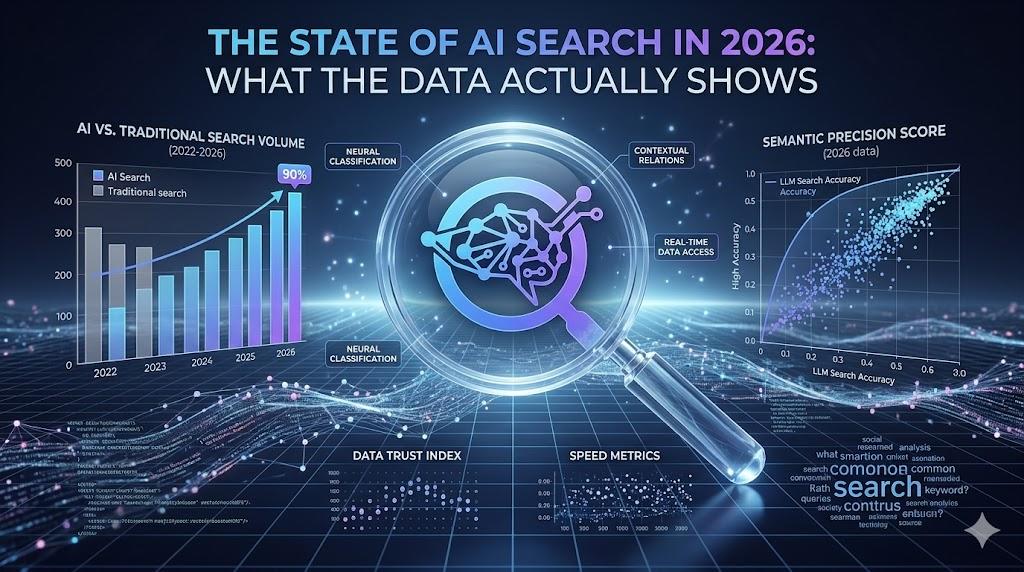
AI search is no longer a trend to monitor — it is the primary discovery channel for a large and growing share of commercial queries, and most brands are not in the answers. The AI search statistics 2026 picture is one of rapid, uneven adoption: usage of conversational answer engines has grown sharply across consumer and professional audiences, citation patterns are highly concentrated, and the agencies that have built systematic visibility practices are pulling away from those still running last decade’s SEO playbook.
Key Takeaways
- AI answer engines — ChatGPT, Perplexity, Claude, and Gemini — now handle a large and measurable share of commercial and informational queries that previously went to traditional search.
- Citation patterns inside AI answers are highly concentrated: a small number of sources tend to dominate responses to any given query, and displacement is slow once those sources are established.
- Most brands have no systematic process for tracking whether they appear in AI answers, which means they have no baseline from which to measure loss or gain.
- Generative Engine Optimisation (GEO) — building off-site authority and third-party citations so AI systems recommend a brand — is now a distinct discipline from traditional SEO, with its own tooling and measurement requirements.
- Agencies that have added AI visibility services to their retainers report stronger client retention, because the question “are we in the AI answers?” is now a board-level concern for many mid-market businesses.
- Schema markup and structured content improve AI extractability, but third-party citation authority is the harder and more decisive factor in whether a brand appears in AI-generated answers.
How Big Is AI Search, Actually?
AI search is large enough to move revenue, and the trajectory is steeper than most agency forecasts assumed two years ago. ChatGPT crossed 100 million weekly active users well before 2025, and usage has continued to compound. Perplexity has positioned itself explicitly as a search replacement and has attracted significant enterprise adoption. Google’s AI Overviews now appear on a substantial proportion of Google Search results pages, meaning even users who never open a dedicated AI app are receiving AI-generated answers as their first result.
The honest caveat: precise, independently verified query-volume figures for AI answer engines are not yet published with the regularity or methodology rigour of traditional search data. Anyone quoting a specific percentage of “all searches” that are now AI-handled should be pressed on their source. What the available signals do show — from traffic pattern analysis, from publisher referral data, and from the behaviour of enterprise buyers — is that AI answer engines are now a primary discovery surface, not a secondary one. The agencies we see building practices around this are not doing so speculatively. They are responding to clients who are already losing referral traffic they cannot account for through traditional analytics.
Citation Concentration: The Pattern That Keeps Showing Up
The most consequential AI search statistic in 2026 is not adoption — it is concentration. Across the audits and query samples we see, AI answers to any given commercial or informational query tend to draw from a narrow pool of sources. A handful of domains, publications, and entities get cited repeatedly; the rest do not appear at all.
This is not random. AI language models weight sources that have strong third-party authority signals — consistent mentions across reputable publications, structured and extractable content, and clear entity definitions. A brand that has invested in building those signals tends to appear. A brand that has not tends to be invisible, regardless of how well its website ranks in blue-link search.
The implication for agencies is uncomfortable but important: a client can have a first-page Google ranking and zero presence in AI answers. These are now separate problems requiring separate solutions. AI citation and share-of-voice tracking across ChatGPT, Perplexity, Claude, and Gemini is the only way to know which situation a client is actually in — and most clients do not know.
What GEO and AEO Mean in Practice
Generative Engine Optimisation (GEO) is the practice of building a brand’s off-site authority, third-party citations, and content footprint so generative AI systems — ChatGPT, Perplexity, Claude, and Gemini — recommend and cite it. It is the off-site, authority-building discipline. You can read a full explanation of what generative engine optimisation is and how it differs from traditional link-building.
Answer Engine Optimisation (AEO) is the on-site counterpart: structuring content and technical signals so AI systems can extract and cite it directly. This includes answer-first content architecture, FAQPage markup (described in plain prose: each question and its answer are tagged so machines can read them as discrete units), and entity clarity. A full breakdown of what answer engine optimisation is covers the on-site mechanics in detail.
The distinction matters because the two disciplines require different work, different skills, and different measurement. Most agencies conflating them into “AI SEO” are underserving clients on both fronts.
Worked Example: Answer-First Content vs. Buried-Answer Content
The single most common on-site failure we see in AI visibility audits is content that contains the right answer but buries it. AI engines extract the first clear, direct response to a query — they do not read to the end of a 600-word preamble. Here is what that looks like in practice.
Before (buried answer — an AI engine will skip this):
“When considering the various factors that influence how businesses are discovered online, and given the rapid evolution of search technology over recent years, it is worth exploring what options exist for companies looking to improve their digital presence. One area that has received increasing attention is the question of how long it takes to see results from optimisation efforts, which can vary considerably depending on a range of variables including industry, competition, and the specific tactics employed.”
After (answer-first — an AI engine can lift this verbatim):
“Most brands begin seeing measurable changes in AI citation frequency within six to twelve weeks of implementing structured content fixes and beginning third-party citation outreach. Compounding authority — the kind that produces consistent, top-of-answer placement — typically takes three to six months of sustained effort. The first step is establishing a baseline: run an AI visibility audit to know where you currently appear across ChatGPT, Perplexity, Claude, and Gemini before measuring any change.”
The second version opens with the answer, scopes the timeline honestly, and ends with a concrete next action. An AI engine can extract it as a standalone response. The first version cannot be cited — it contains no extractable claim.
Agency Uptake: Where the Industry Actually Is
The honest picture of agency adoption in 2026 is a wide distribution. A minority of agencies — typically those with strong technical SEO practices or content-heavy service lines — have built systematic AI visibility offerings and are actively tracking client citation share of voice. A larger group has added AI search language to their proposals without changing the underlying work. And a meaningful segment is still running traditional SEO retainers with no AI visibility component at all, often because their reporting tooling cannot see AI answers and therefore cannot surface the problem to clients.
The agencies in the first group are not necessarily larger or better resourced. What they have is a measurement practice: they know which clients appear in AI answers, which competitors are displacing them, and what changed between audits. That knowledge is what makes the retention conversation defensible. When a client asks “what are we getting for this retainer?”, the answer is not a keyword ranking report — it is a citation share-of-voice trend and a documented record of what moved it.
The agencies still in the third group face a specific risk: clients are beginning to ask the AI visibility question themselves, because their own customers are asking it. A client who discovers their competitor is consistently cited by ChatGPT for their core category query — and their agency had no visibility into this — is a client who starts shopping for a new agency.
Common Misconceptions About AI Search Data
Misconception: “Our Google rankings tell us how we’re doing in AI search.” Reality: Google AI Overviews and conversational answer engines draw from different authority signals than blue-link rankings. A brand can rank first organically and never appear in an AI answer. The two surfaces require separate measurement.
Misconception: “Publishing more content will fix our AI visibility.” Reality: Volume is not the lever. AI engines weight source authority and extractability. A single, well-structured, third-party-cited piece of content will outperform fifty thin pages every time. The agencies selling content volume as an AI visibility fix are selling what is easy to produce and bill, not what actually moves citation share.
Misconception: “AI search is too new to measure reliably.” Reality: The tooling to sample AI answers systematically, track citation frequency, and compare share of voice across competitors exists now. The measurement is imperfect — AI answers are probabilistic and vary by phrasing — but imperfect measurement is vastly better than none. Agencies using this excuse are often protecting a workflow that does not include AI visibility, not making a principled methodological argument.
What the Data Means for Agency Strategy in 2026
The AI search statistics 2026 picture is not one of chaos or early-stage uncertainty — it is one of a channel that has matured faster than most agencies’ service offerings. The brands winning in AI answers right now built their citation authority early, structured their content for extraction, and measured their position systematically. The gap between them and brands that did not is widening, because citation concentration compounds: the more a source is cited, the more AI models weight it in future training and retrieval.
For agencies, the strategic implication is direct: AI visibility is not a future service line to consider — it is a current client need that is either being addressed or being ignored. The agencies that have built the measurement practice are retaining clients and winning new ones on the strength of it. The agencies that have not are at risk of being displaced by the question their clients are already asking.
If you do not yet have a baseline for where your clients appear across the four major conversational answer engines, the right first move is to establish one. Run a free AI visibility audit to see where a brand currently stands across ChatGPT, Perplexity, Claude, and Gemini — and start the measurement practice from there.
Frequently Asked Questions
What are the most important AI search statistics to track in 2026?
The most actionable AI search statistics in 2026 are citation frequency (how often a brand appears in AI answers), share of voice relative to competitors, and which query categories trigger citations. Adoption figures matter for context, but citation-level data is what drives agency strategy and client reporting.
How is AI search different from traditional Google search?
Traditional Google search returns a ranked list of links; AI search returns a synthesised answer that cites selected sources. The authority signals that determine which sources are cited differ from those that drive blue-link rankings, so a brand can rank first on Google and be entirely absent from AI-generated answers.
What is generative engine optimisation (GEO)?
Generative Engine Optimisation (GEO) is the practice of building a brand’s off-site authority, third-party citations, and content footprint so AI systems — ChatGPT, Perplexity, Claude, and Gemini — recommend and cite it in their answers. It is the off-site, authority-building counterpart to on-site answer engine optimisation.
How long does it take to improve AI search visibility?
Most brands see measurable changes in citation frequency within six to twelve weeks of implementing structured content fixes and beginning third-party citation outreach. Sustained, top-of-answer placement typically takes three to six months of consistent effort. Establishing a baseline audit first is essential to measuring any change.
Can agencies track AI search visibility across multiple clients?
Yes. Dedicated GEO platforms audit AI answer engines systematically, tracking citation frequency and share of voice across ChatGPT, Perplexity, Claude, and Gemini for multiple clients simultaneously. White-label reporting options allow agencies to deliver these insights under their own brand without building the infrastructure themselves.
Why do some brands appear in AI answers while others do not?
AI citation patterns are driven by third-party authority signals, content extractability, and entity clarity — not by website traffic or traditional keyword rankings. Brands with consistent mentions across reputable publications, structured and answer-first content, and clear entity definitions are cited far more frequently than those without these signals.