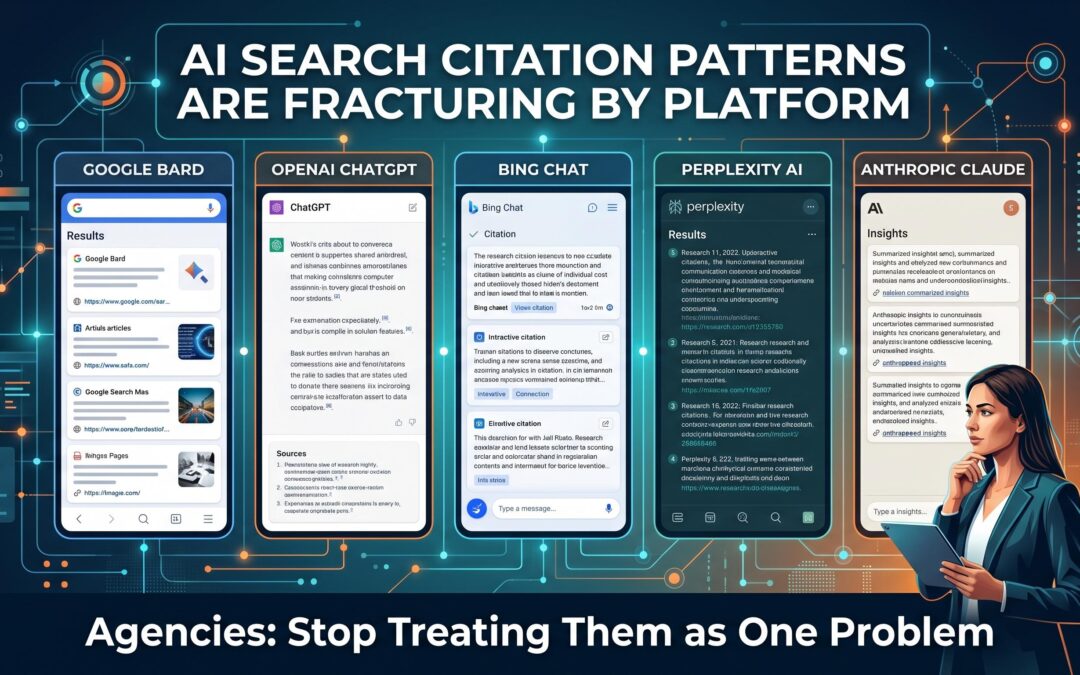
AI search citation patterns are diverging sharply across platforms in 2026, and the agencies still treating generative engine optimisation as a single unified discipline are already falling behind. The data published across Q1 and Q2 this year makes one thing unmistakably clear: where your content gets cited — and whether it gets cited at all — depends heavily on which AI engine is doing the answering.
The Citation Concentration Problem
Start with the scale of the issue. In May 2026, 5WPR released its AI Platform Citation Source Index, synthesising data from six major citation studies. The index covers more than 680 million individual citations across ChatGPT, Google AI Overviews, Perplexity, Gemini, and Claude. The headline finding should concern every agency managing organic visibility: the top 15 domains capture 68% of all consolidated AI citation share — a concentration far more extreme than Google PageRank ever produced.
That is not a long tail. That is a near-monopoly on AI-generated answers, and most of your clients are not in those 15 domains. The question is not whether to care about this. The question is how to respond to it intelligently.
Each Platform Cites Differently — and the Gap Is Widening
The more operationally important finding is that citation behaviour varies dramatically between engines. Claude relies on user-generated content far more than other models, with limited-control citations — reviews and social media — running at rates 2–4 times higher than competing models across all sectors studied. Meanwhile, Perplexity leans heavily on social and Reddit (31% social, 24% Reddit in January), while Gemini relies more on editorial sources like Medium and cites far fewer social domains overall.
SearchGPT presents its own anomaly. SearchGPT cites official hotel websites at 38.1%, while competing models range from 16.7% to 22.4% — the largest single-model divergence observed in any sector. The practical conclusion from Yext’s research is blunt: there is no single “AI optimisation” strategy.
Agencies that have been selling clients a unified GEO approach — one content strategy to rule all platforms — are selling a fiction. The platforms are not converging. They are diverging.
The Organic Ranking Assumption Is Breaking Down
There is a second structural shift that deserves more attention than it is getting. For most of 2025, the working assumption was that ranking in Google’s top 10 was a reliable proxy for being cited in AI Overviews. That assumption is now demonstrably wrong. An updated Ahrefs analysis of 863,000 keywords and 4 million AI Overview URLs found that only 38% of cited pages also appeared in the top 10 results for the same query — down from 76% in the previous version of the study.
The remaining citations are split almost evenly between results appearing in positions 11–100 (31.2%) and beyond position 100 (31.0%). That is a profound shift. It means that a page ranking 85th for a query can be cited in an AI Overview ahead of pages ranking 3rd and 4th. Traditional rank tracking, on its own, tells you almost nothing about AI citation probability.
What Is Actually Driving Citation Selection
If rank is a weakening signal, what is replacing it? The evidence points to several factors that agencies should be building into their workflows now.
Content freshness is non-negotiable. Pages that go more than three months without an update are over 3 times more likely to lose visibility compared with recently refreshed pages. This is not a minor ranking factor. It is a threshold condition.
Page structure matters more than most agencies realise. Analysis of 100 AI Overview citations found that 55% of AI Overview citations come from the top 30% of a page, with a further 24% from the middle section, while the bottom of the page accounts for just 21% of citations. The exception worth noting: FAQ sections generate a meaningful share of bottom-of-page citations, addressing specific, discrete questions.
Entity authority is now the baseline. Only 274,455 domains have ever appeared in AI Overviews out of 18.4 million in Google’s index — Google is extraordinarily selective about citation sources. AI systems do not just evaluate individual pages; they evaluate entity authority — how consistently a brand signals expertise across the entire web.
Off-site presence is a direct input, not a soft signal. Reddit is the number one source across every major AI engine, cited at roughly 40% frequency across large language models. For B2B brands, LinkedIn’s rise is the most strategically important shift: LinkedIn content is now a direct input to AI answers about a market. If your clients have no presence in the communities where AI engines are sourcing answers, no amount of on-site optimisation will compensate.
The Conversion Premium Changes the Business Case
One data point that should reframe how agencies pitch this work to clients: the traffic that does arrive from AI citations converts at a dramatically higher rate than traditional organic. Ahrefs data shows that just 0.5% of total traffic from AI platforms generated 12.1% of signups in a 30-day period. Semrush data corroborates this, showing AI search visitors worth 4.4 times traditional organic visitors.
This matters for how agencies frame the value of citation work. The volume numbers will often look unimpressive. The quality numbers are extraordinary. Clients who are only measuring AI visibility through traffic volume are misreading the channel entirely.
Two Things Agencies Should Do Right Now
First, stop reporting on AI citation performance as a single aggregate metric. Tracking mid- to lower-funnel prompts across multiple AI platforms and commercial categories separately is the only way to understand where a client actually has coverage and where they have gaps. A brand that is well-cited on Perplexity and invisible on Google AI Overviews has a very different problem than one with the reverse profile.
Second, build a content refresh cadence into every retainer. The freshness data is unambiguous. AI models prioritise fresh, accurate content when generating answers, treating recency as a key signal of trust, especially when users compare options or make decisions. A quarterly content audit is no longer optional infrastructure — it is the minimum viable programme for maintaining AI citation visibility.
The agencies that will be well-positioned by the end of 2026 are not the ones who found a single optimisation trick. They are the ones who built platform-specific citation monitoring, invested in off-site presence in the communities AI engines actually trust, and stopped conflating traditional organic rankings with AI visibility. Those are different problems. They require different solutions.
Frequently Asked Questions
Does ranking in Google’s top 10 guarantee citation in AI Overviews?
No. Updated Ahrefs data shows only 38% of pages cited in AI Overviews also rank in the top 10 for the same query, down from 76% previously. Nearly a third of citations now come from pages ranking beyond position 100. Traditional rank is a weakening proxy for AI citation probability.
Do different AI platforms cite different types of sources?
Yes, significantly. Perplexity heavily favours Reddit and social sources. Gemini leans toward editorial domains. Claude over-indexes on user-generated content like reviews. SearchGPT cites official brand websites at nearly double the rate of other models. A single optimisation strategy cannot address all platforms simultaneously.
How often should content be updated to maintain AI search citation visibility?
At minimum, every quarter. Data shows pages going more than three months without an update are over three times more likely to lose AI citation visibility than recently refreshed pages. AI models treat content recency as a direct trust signal, particularly for decision-stage queries.
How should agencies measure the value of AI citation visibility for clients?
Do not rely on traffic volume alone. AI-referred visitors convert at dramatically higher rates than traditional organic visitors — Ahrefs data shows 0.5% of AI traffic generating over 12% of signups. Measure citation frequency, branded search lift, and assisted conversions alongside direct referral traffic.