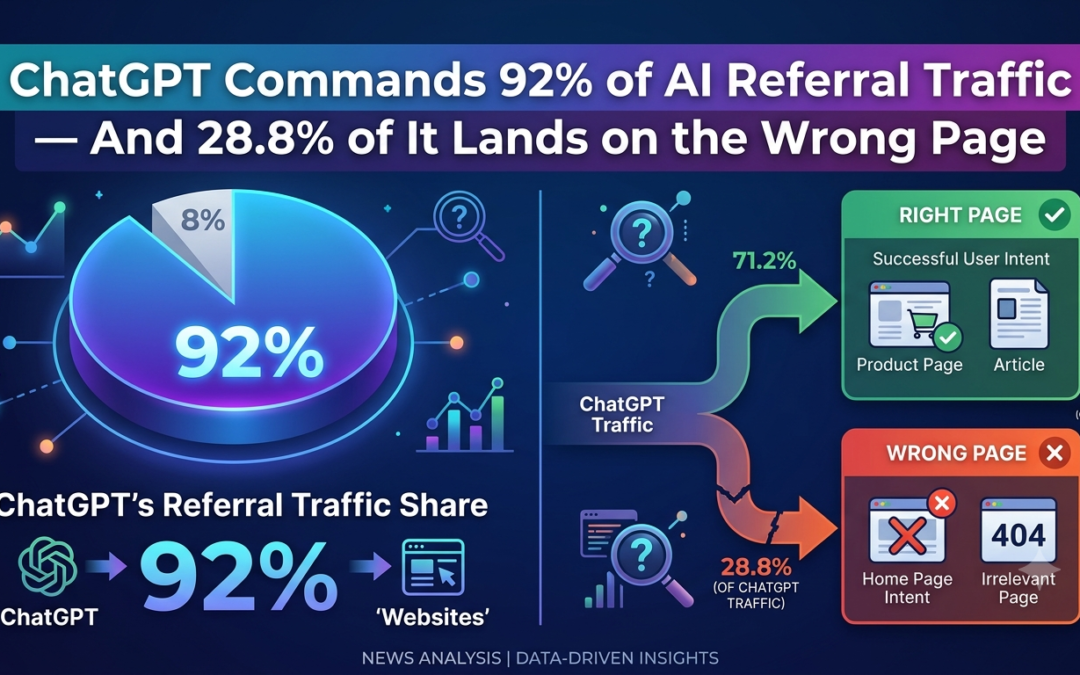
Previsible released its third AI Traffic Study on 6 July 2026 via BusinessWire, analysing 6.77 million LLM-driven sessions across 166 websites spanning November 2024 through May 2026. The headline finding: ChatGPT commands 92.4% of all trackable standalone AI referral traffic — and it is still gaining share. The study's most operationally urgent finding, however, is buried beneath that number: according to the Previsible data, 28.8% of ChatGPT referrals land on a client's internal search page rather than the answer page — a conversion problem hiding inside an AI visibility win.
Key Takeaways
- ChatGPT accounted for 92.4% of trackable standalone LLM referral traffic across 166 GA4 properties, November 2024–May 2026 (Previsible, July 2026).
- 28.8% of ChatGPT referrals land on internal site search results pages rather than a relevant content page — the model trusts the domain but cannot always identify the right URL (Search Engine Land, July 2026).
- Claude grew 64x over the 19-month study period (133 sessions in November 2024 to 8,528 in May 2026) and overtook Perplexity in monthly referral sessions in March 2026 (Search Engine Land, July 2026).
- Perplexity has fallen 61% from its March 2025 peak; Copilot has collapsed 96% from its August 2025 high (Previsible, July 2026).
- Google launched dedicated Search Generative AI Performance Reports in Search Console on 3 June 2026, providing impression data for AI Overviews and AI Mode — but no click data (Google Search Central, June 2026).
Context: A Consolidating Market With a Hidden Leak
The Previsible study — released via BusinessWire on 6 July 2026 and authored by David Bell, the company's chief product officer and co-founder — is the industry's longest-running dataset of its kind. It covers 166 GA4 properties held constant across the full 19-month window, meaning the trajectories reflect genuine behavioural change rather than sample expansion.
The consolidation story is stark. Monthly standalone LLM sessions grew 9.9x over the study period, reaching 644,478 in May 2026 (Search Engine Land, July 2026). ChatGPT's monthly referral sessions grew 12.8x — from 47,606 in November 2024 to 610,910 in May 2026 — with no sign of slowing. Six months earlier, in December 2025, ChatGPT held roughly 84% share, followed by Perplexity at 8.9%, Gemini at 4.5%, Copilot at 2.1%, and Claude at 0.6%. The field has since collapsed toward the leader.
Important framing: this study measures standalone LLM referral traffic specifically (Previsible, July 2026). AI discovery inside Google's own results — including AI Overviews and AI Mode — almost certainly represents a larger volume of AI-influenced traffic than all standalone platforms combined, but it operates on a fundamentally different measurement paradigm and is excluded from the Previsible dataset. Google AI Overviews is a critical part of the broader AI search context, but it is not a standalone referral engine in the same measurement frame.
Beneath the headline share numbers, the platform dynamics are volatile. In November 2025, monthly sessions fell 50% in a single month, driven almost entirely by ChatGPT referrals dropping from 448,412 to 213,345, before recovering to 442,609 in December (Search Engine Land, July 2026). The likely cause was a model-level change that caused ChatGPT to favour Wikipedia and Reddit over other domains. One vendor's product decision halved AI referral traffic overnight — a structural risk agencies must account for in client reporting.
Claude's trajectory deserves attention. Claude grew 64x over 19 months, from 133 sessions in November 2024 to 8,528 in May 2026, and overtook Perplexity in March 2026 (Search Engine Land, July 2026). Its referrals skew toward developers, technical buyers, and professional services audiences — a different user profile than ChatGPT's broader base. Gemini grew 3.2x and now stands as the second-largest standalone referrer by volume (Previsible, July 2026), though its absolute numbers remain small relative to ChatGPT.
The Agency "So What": An AI Visibility Win Can Mask a Conversion Failure
The 28.8% internal-search-landing figure is the most operationally significant number in the study. The pattern persists across verticals and time periods, suggesting it is structural to retrieval-augmented generation rather than a temporary quirk (Search Engine Land, July 2026). ChatGPT trusts a domain enough to send a visitor, but cannot always identify the right page — so it defaults to the site's own search box. Across all industries in the study, roughly 25% of AI-referred traffic lands on internal search results pages (Search Engine Land, July 2026). For SaaS sites specifically, that figure rises to 34.6%.
For agencies, this reframes the conversation with clients. Earning a ChatGPT citation is a necessary but insufficient condition for capturing value from AI referral traffic. If the cited URL is a domain root or a poorly structured page, the model may route the visitor to internal search rather than the answer. That is a content architecture and answer engine optimisation problem — one that sits squarely in the agency's remit.
A parallel measurement gap is closing on the Google side. On 3 June 2026, Google launched dedicated Search Generative AI Performance Reports in Search Console, providing impression data for AI Overviews and AI Mode (Google Search Central, June 2026). The report covers impressions, pages, countries, devices, and dates — but does not include click data (Search Engine Land, June 2026). The report is rolling out initially to a subset of UK-based properties, with broader availability expected in subsequent months. Alongside the report, Google introduced a toggle allowing site owners to opt their content out of AI Overviews and AI Mode — without penalty to standard organic rankings.
Action This Week
- Audit internal site search as an acquisition surface. Pull GA4 data for sessions landing on internal search results pages and filter by referrer (chat.openai.com and related ChatGPT domains). If that segment is material, treat internal search UX as a conversion priority, not a housekeeping task.
- Map cited URLs against page quality. Identify which of your clients' pages ChatGPT is currently citing. If citations are landing on thin, unstructured, or navigational pages, that is the structural fix — not more content volume. Structured, extractable content is what earns a direct-page citation rather than a domain-level punt to internal search.
- Do not abandon Claude and Gemini tracking. Claude's 64x growth and its overtaking of Perplexity in March 2026 signal that the multi-engine picture is shifting. A ChatGPT-only measurement strategy is already incomplete for professional-services and B2B clients whose buyers skew toward Claude's user profile. Cross-engine citation and share-of-voice tracking across all four major engines gives the full picture.
- Advise clients carefully on the GSC opt-out toggle. For most clients, the better path is to establish an AI impression baseline first, then make an informed decision. Pairing GSC impression data with a cross-engine citation audit — tracking which pages appear in ChatGPT, Claude, and Perplexity responses — gives the full picture before any opt-out decision is made.
The Previsible data confirms that AI referral traffic is real, growing, and concentrated — but the agencies that will extract the most value from it are those who look past the share-of-voice headline and fix what happens after the click.
Frequently Asked Questions
What does the Previsible AI Traffic Study actually measure?
The study measures referral sessions from standalone LLM platforms — ChatGPT, Claude, Gemini, Perplexity, and Copilot — tracked via GA4 referrer data across 166 websites from November 2024 to May 2026. It explicitly excludes Google AI Overviews, which do not generate trackable referral sessions in the same way.
Why does ChatGPT send so much traffic to internal site search pages?
According to Previsible's July 2026 study, ChatGPT trusts a domain broadly but often cannot identify the specific page that answers a query, so it defaults to the site's own search box. This pattern persists across verticals and time periods, suggesting it is structural to retrieval-augmented generation rather than a temporary quirk.
Should agencies advise clients to opt out of Google AI features using the new GSC toggle?
For most clients, the better path is to establish an AI impression baseline first, then make an informed decision. Pairing GSC impression data with a cross-engine citation audit — tracking which pages appear in ChatGPT, Claude, and Perplexity responses — gives the full picture before any opt-out decision is made.
Is Claude worth tracking if it only represents a small share of AI referral traffic?
Yes. Claude grew 64x over 19 months and overtook Perplexity in March 2026 (Previsible, July 2026). Its referrals skew toward developers, technical buyers, and professional services — high-value audiences for B2B clients. Share of voice on Claude is disproportionately important relative to its raw session volume.