Most brands implementing schema markup for AI search are doing it in the wrong order — spending weeks on Product and BreadcrumbList markup while the two types that actually drive AI citation remain untouched. The correct sequence is FAQPage schema first, then Entity schema (Organisation, Person, or Product), and everything else only after those two are solid. Get the order right and you give AI answer engines the extraction handles they need; get it wrong and you are optimising for a ranking system that is no longer the primary decision surface for a large and growing share of your audience.
Key Takeaways
- FAQPage schema is the single highest-leverage schema type for AI search because it packages a question and a machine-readable answer in a format every major answer engine is built to extract.
- Entity schema (Organisation, Person, or Product markup) is the second priority — it tells AI systems who or what a brand is, which is the prerequisite for consistent citation across ChatGPT, Perplexity, Claude, and Gemini.
- The schema.org FAQPage specification requires each answer to be visible on the page — hidden or JavaScript-rendered answers do not qualify and will not be extracted.
- Schema markup is a necessary condition for AI citation, not a sufficient one. Off-site authority and third-party citations — the domain of generative engine optimisation — determine whether an engine trusts a brand enough to cite it at all.
- Implementing schema in the wrong order (e.g. BreadcrumbList before FAQPage) wastes implementation cycles on signals that have negligible impact on AI answer extraction.
- Every schema implementation should be validated against Google Search Central's structured data testing tools before considering the work done — invalid markup is silently ignored by AI systems.
Why Schema Markup Matters Differently for AI Search Than for Blue-Link SEO
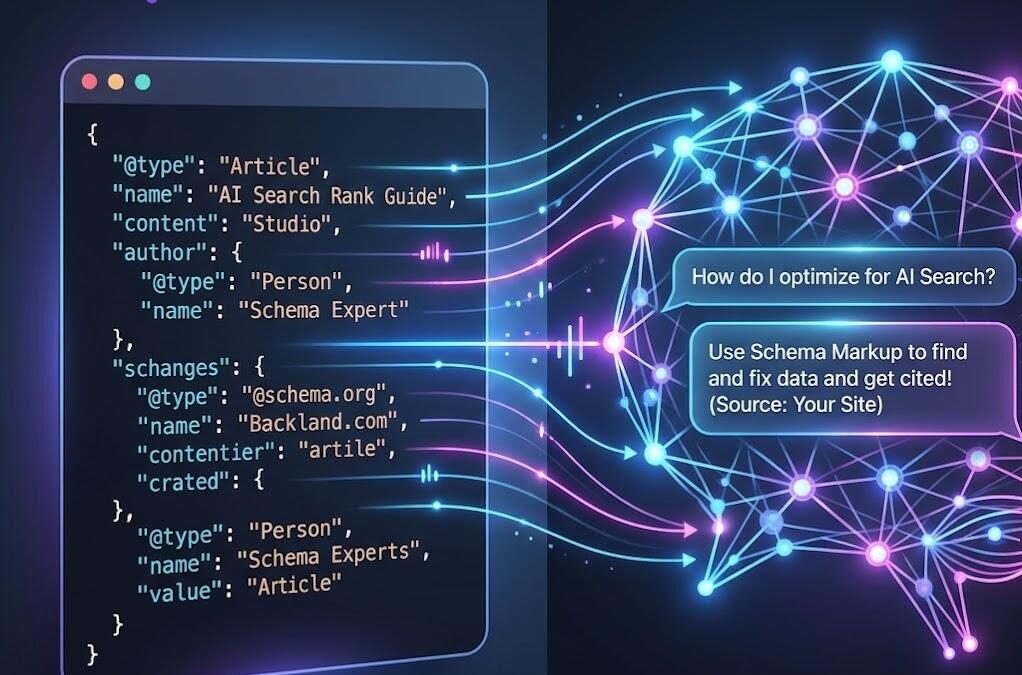
Schema markup matters for AI search because it converts prose into structured, machine-readable signals that answer engines can extract without having to infer meaning from surrounding context. In traditional blue-link SEO, schema markup influenced rich results — star ratings, FAQ dropdowns, sitelinks. In AI search, the function is more fundamental: it tells a language model exactly what question a piece of content answers and exactly what the answer is, in a format that requires no interpretation. That is a qualitatively different job, and it explains why the priority order for AI search diverges sharply from the priority order most SEO guides still recommend.
Answer Engine Optimisation (AEO) — the practice of structuring a brand's on-site content and signals so AI answer engines can extract and cite it directly — treats schema markup as one of its core levers. It is the on-site, extraction-focused counterpart to the off-site authority work of GEO. Schema alone does not earn citations; but without it, even well-written content is harder for AI systems to parse with confidence.
FAQPage Schema: Implement This First
FAQPage schema is the first implementation priority because it is the most direct structural match for how AI answer engines retrieve and surface information. When a user asks ChatGPT or Perplexity a question, the engine is looking for a question-answer pair it can trust. FAQPage markup — defined in the schema.org FAQPage specification — packages exactly that: a page containing one or more questions and their accepted answers, each labelled unambiguously for machine consumption.
The Google Search Central FAQ structured data documentation is explicit on one point that trips up most implementations: every answer must be visible in the page's HTML. If the answer text is hidden behind a toggle, loaded via JavaScript after the initial render, or exists only in the schema markup itself without a corresponding visible element, it does not qualify. AI crawlers and search systems alike require the content to be present in the rendered DOM. This is not a technicality — it is the most common reason FAQPage implementations fail silently.
What Good FAQPage Implementation Looks Like in Practice
The worked example below is the most useful thing in this article. It shows the difference between a buried-answer paragraph — the format most content teams default to — and an answer-first version that FAQPage markup can wrap and that an AI engine can lift verbatim.
Before (buried answer — hard to extract):
"There are a number of factors that influence how long it takes for a business to rank in local search results. These include the age of the domain, the quality of citations, the consistency of NAP data across directories, and the competitiveness of the local market. In some cases, businesses may start to see movement within a few weeks, while in more competitive markets the process can take considerably longer, sometimes several months or more."
After (answer-first — extractable by an AI engine):
Q: How long does it take for a business to rank in local search results?
Most businesses see initial movement in local search rankings within four to twelve weeks of fixing citation consistency and NAP data. In competitive markets, meaningful ranking improvement typically takes three to six months. The primary variables are domain age, citation quality, and local market competitiveness.
The after version answers the question in the first sentence, states a concrete range, names the variables, and is self-contained — an AI engine can cite it without needing the surrounding paragraph for context. Add FAQPage markup so each question and answer is machine-readable, and you have given the engine both the structured signal and the visible content it needs. The before version requires the engine to infer the question, locate the answer buried mid-paragraph, and decide whether the hedged language is worth citing. Most of the time, it will find a cleaner source instead.
Which Pages to Prioritise for FAQPage Markup
Not every page warrants FAQPage schema. Prioritise pages that already answer questions users are likely to ask AI systems: service pages, product pages, how-to guides, and any page that currently ranks for question-format queries. A service page for a law firm that answers "What does a commercial lease solicitor do?" is a higher-value FAQPage candidate than a blog post about industry trends. Work through your highest-traffic, highest-intent pages first, then expand.
Entity Schema: Implement This Second
Entity schema is the second priority because it solves a different but equally critical problem: it tells AI systems who or what a brand is. Without clear entity signals, AI engines may conflate a brand with a similarly named competitor, cite the wrong entity, or simply omit the brand because they cannot resolve its identity with confidence. This is the entity-fragmentation problem, and it is more common than most agencies realise — particularly for multi-location businesses, businesses that have rebranded, or businesses operating in crowded verticals where several companies share similar names.
The relevant schema types here are Organisation (for businesses), Person (for individuals building a personal brand or professional authority), and Product (for specific products that appear in AI-generated recommendations). Organisation markup should include the brand's legal name, URL, logo, founding date, contact information, and — critically — its social profiles and any Wikidata or Wikipedia identifiers. These identifiers are what allow AI systems to cross-reference on-page claims against the broader knowledge graph and arrive at a confident entity match.
The Connection Between Entity Schema and Knowledge Panel Authority
Entity schema does not operate in isolation. It works in conjunction with NAP (name, address, phone number) consistency across directories, a Wikidata entry where one is warranted, and the Knowledge Panel that Google surfaces for established entities. Together, these signals constitute what practitioners call entity authority — the degree to which AI systems can resolve a brand's identity unambiguously. Schema markup is the on-site anchor for that authority; the off-site signals are what make it credible. An Organisation schema block that contradicts the brand's Wikidata entry or lists a phone number that differs from its Google Business Profile will undermine rather than reinforce entity authority.
Common Misconceptions About Schema and AI Search
Myth: More schema types means more AI visibility. Reality: AI engines do not reward schema volume. They reward schema accuracy and relevance. A page with valid FAQPage and Organisation markup consistently outperforms a page with eight schema types, half of which are inaccurate or irrelevant to the page's content. The instinct to implement every available type comes from a blue-link SEO mindset where more signals generally helped; in AI search, noise degrades trust.
Myth: Schema markup alone will get a brand cited by AI engines. Reality: Schema is a necessary condition, not a sufficient one. What we see consistently across agency audits is that brands with clean, valid schema but thin off-site authority still get passed over in favour of brands with stronger third-party citation footprints. Schema tells the engine what a brand says about itself; third-party citations tell the engine what others say about it. AI systems weight both, and off-site authority is the harder signal to fake — which is exactly why it carries more weight. This is the domain of generative engine optimisation services, not schema alone.
Myth: If schema validates in a testing tool, it is working. Reality: Validation confirms the markup is syntactically correct. It does not confirm that the content is visible in the rendered DOM, that the answers are substantive enough to be worth citing, or that the page has sufficient authority for an AI engine to trust it. Validation is the floor, not the ceiling.
These misconceptions persist for a predictable reason: schema is easy to bill and report on. An agency can implement twenty schema types, run a validation report, and hand the client a green-light dashboard. It looks like progress. The harder work — restructuring content to be answer-first, building off-site citation authority, tracking whether AI engines are actually citing the brand — is more difficult to package and explain. That incentive gap is why so many brands have technically valid schema and no AI citations to show for it.
What to Implement After FAQPage and Entity Schema
Once FAQPage and Entity schema are implemented and validated, the next tier depends on the vertical. For e-commerce and product-led businesses, Product schema with accurate pricing, availability, and review aggregation is the logical next step — AI shopping assistants in ChatGPT and Perplexity actively use this data. For service businesses, HowTo schema on instructional content can extend the extraction surface. For publishers and content-heavy sites, Article and BreadcrumbList schema help AI systems understand content hierarchy and recency. None of these should be implemented before the first two are solid — they are amplifiers, not foundations.
Tracking Whether Schema Is Actually Driving AI Citations
Schema implementation without measurement is a guess. The pattern that keeps showing up across agency work is that teams implement schema, validate it, and then have no mechanism to determine whether AI engines are actually extracting and citing the content. Tracking this requires sampling AI answers across ChatGPT, Perplexity, Claude, and Gemini for the queries a brand wants to appear in — repeatedly, over time, with competitor benchmarking alongside. That is not a spreadsheet-and-an-afternoon problem. The query set is large, the engines give different answers to the same question on different days, and the signal only becomes meaningful when you can see trends across weeks rather than a single snapshot. AI citation and share-of-voice tracking exists precisely because manual sampling at this scale is not operationally viable for agencies managing multiple clients.
Schema markup for AI search is not a checklist exercise. It is a sequenced, validated, measurement-backed programme — and the sequence matters more than most guides acknowledge. FAQPage first, Entity second, everything else after. Get those two right, keep the answers visible and answer-first, and you have built the extraction infrastructure that AI engines need to cite a brand with confidence. If you want to see where a brand currently stands across the four major answer engines before you start, a free AI visibility audit is the fastest way to establish a baseline.
Frequently Asked Questions
What is FAQPage schema and why does it matter for AI search?
FAQPage schema is structured markup, defined by the schema.org FAQPage specification, that labels a page's questions and answers in a machine-readable format. It matters for AI search because answer engines like ChatGPT and Perplexity are built to extract question-answer pairs, and FAQPage markup makes that extraction unambiguous and reliable.
Does schema markup guarantee that an AI engine will cite my content?
No. Schema markup is a necessary condition for reliable AI citation, not a sufficient one. AI engines also weigh off-site authority, third-party citations, and content quality. A brand with valid schema but weak off-site authority will still be passed over in favour of brands with stronger citation footprints across the web.
Which schema type should I implement first for AI search visibility?
FAQPage schema should be implemented first. It directly matches the question-answer retrieval pattern that AI answer engines use. Entity schema — Organisation, Person, or Product — is the second priority, establishing who or what the brand is so AI systems can cite it consistently and without confusion.
Can FAQPage schema answers be hidden or loaded via JavaScript?
No. The Google Search Central FAQ structured data documentation requires that every answer be visible in the page's rendered HTML. Answers hidden behind toggles or loaded dynamically after initial render do not qualify. The content must be present in the DOM for AI crawlers and search systems to extract it.
How does Entity schema help with AI citation?
Entity schema — Organisation, Person, or Product markup — tells AI systems who or what a brand is, enabling confident entity resolution. Without it, AI engines may conflate a brand with a similarly named competitor or omit it entirely. Entity schema works alongside NAP consistency, Wikidata entries, and Knowledge Panel signals to build entity authority.
How do I know if my schema markup is actually improving AI visibility?
Validation tools confirm syntactic correctness but cannot tell you whether AI engines are citing your content. Measuring AI citation requires repeated sampling of answers across ChatGPT, Perplexity, Claude, and Gemini for target queries, tracked over time and benchmarked against competitors — a process that requires dedicated tooling rather than manual spot-checks.