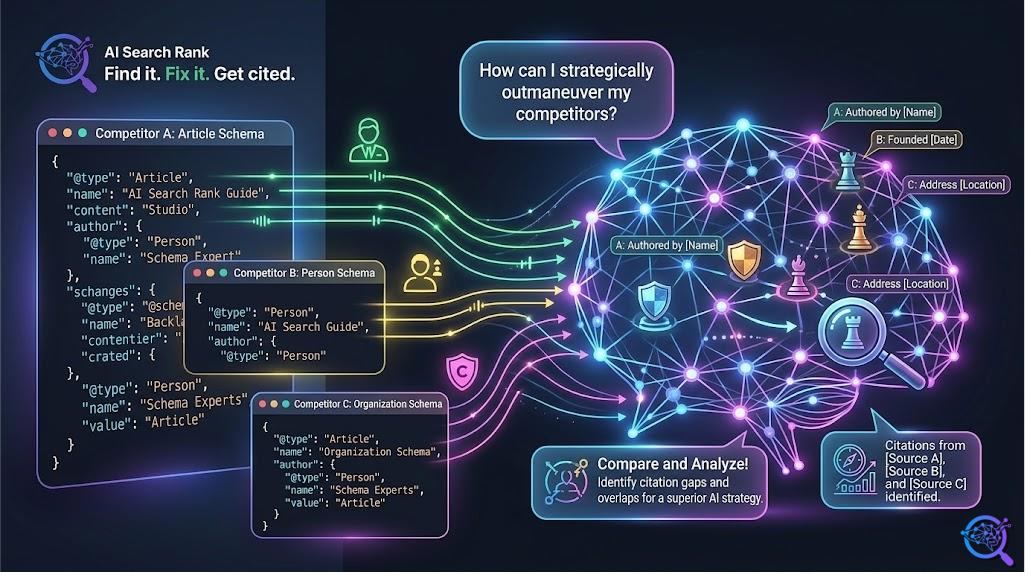
Reading competitor AI citations strategically means systematically sampling how ChatGPT, Perplexity, Claude, and Gemini answer the questions your clients want to own — then reverse-engineering exactly why a competitor is cited and your client is not. Done properly, it tells you which content gaps to close, which third-party sources to earn, and which entities to strengthen, in priority order.
Key Takeaways
- Competitor AI citations reveal the specific content structures, third-party sources, and entity signals that AI answer engines are currently rewarding in a given topic area.
- A single query sample is not a strategy — meaningful analysis requires repeated sampling across ChatGPT, Perplexity, Claude, and Gemini, because citation patterns differ materially by engine.
- The most actionable gap is usually not a missing page but a missing third-party mention: a trade publication, a review platform, or a directory that cites the competitor but not your client.
- Answer-first content structure is a prerequisite for citation — AI engines extract the first clean, direct sentence of an answer; a buried conclusion will not be lifted regardless of how good the surrounding prose is.
- Citation share of voice — the proportion of sampled answers in which a brand appears — is the metric that turns a one-off audit into a trackable, client-reportable number.
- Competitor citation analysis is a diagnostic, not a one-time exercise; the engines re-rank constantly, and a gap that closes this month can reopen next month without ongoing monitoring.
Why Competitor AI Citations Are the Fastest Diagnostic You Have
Competitor AI citations are faster to act on than a traditional content gap analysis because they show you what is already working inside the engines, not just what ranks in blue-link results. When a competitor is cited in an AI answer and your client is not, the engine has already done the evaluation — it has judged that competitor's content, entity signals, and third-party authority as more trustworthy for that query. Your job is to read that judgment and understand it.
This is the core logic of generative engine optimisation — building the off-site authority, third-party citations, and content footprint that cause AI systems to recommend and cite a brand. Competitor analysis is how you find out where the gap is widest and where closing it will move the needle fastest.
Step One: Build a Query Set That Reflects Real Buyer Intent
The query set is the foundation of the entire analysis, and most agencies get it wrong by starting with branded or vanity queries. Start instead with the questions a buyer asks before they know which brand they want.
For a B2B software client, that might be: "What is the best project management tool for remote engineering teams?" or "How do I choose a time-tracking tool for a distributed agency?" For a professional services firm, it might be: "Which accounting firms specialise in e-commerce businesses?" These are the queries where AI answers are replacing the first page of Google results, and they are the queries where competitor citations do the most commercial damage.
Build a list of 20–40 queries across three intent layers: awareness ("how do I solve X"), evaluation ("best options for X"), and decision ("X vs Y"). Run each query manually across ChatGPT, Perplexity, Claude, and Gemini. Record every brand cited, every source linked, and the exact phrasing used to introduce each citation. Do this at least twice per engine on separate days — answer variability is real, and a single sample will mislead you.
Step Two: Map Citations to Their Source Signals
Once you have a citation map, the next question is: where is the engine pulling this from? AI answer engines draw on a combination of on-site content, third-party mentions, and entity signals. Identifying which of these is driving a competitor's citation tells you exactly where to invest.
There are three source types to look for:
- On-site content: The competitor has a page that answers the query in a clean, extractable format — a direct answer in the first sentence, followed by supporting detail. This is an answer engine optimisation problem for your client.
- Third-party citations: A review platform (G2, Capterra, Trustpilot), a trade publication, an industry directory, or a news outlet has written about the competitor in a way the engine trusts. This is a generative engine optimisation problem — your client needs equivalent third-party coverage.
- Entity strength: The competitor has a well-populated Wikidata entry, consistent NAP (name, address, phone) data across directories, a Knowledge Panel, and schema markup (Organisation, Product, FAQPage) that makes their identity unambiguous to AI systems. This is an entity authority problem.
In practice, most citation gaps are a combination of all three — but one usually dominates. Identifying which one saves months of misdirected effort.
Worked Example: Before and After an Answer-First Rewrite
Here is the kind of content gap that shows up constantly in competitor citation audits. A competitor is cited in Perplexity for the query "What is the best HR software for small construction companies?" Your client has a page on the same topic. You pull both pages and compare the opening paragraphs.
Before (your client's page — buried answer):
"Managing human resources in the construction industry presents unique challenges. From tracking certifications and compliance requirements to managing shift workers across multiple sites, HR teams in this sector face a level of complexity that generic software often fails to address. In this guide, we'll walk through the key features to look for, common pitfalls to avoid, and our top recommendations for small construction businesses."
An AI engine scanning this paragraph finds no direct answer. It finds context and a promise of an answer later. It will not lift this as a citation.
After (answer-first rewrite):
"The best HR software for small construction companies is one that handles certification tracking, multi-site shift management, and compliance reporting in a single platform — capabilities that generic HR tools typically lack. [Client brand] is built specifically for construction teams of 10–150 employees, with automated licence expiry alerts and site-level scheduling built in."
The rewritten version leads with the direct answer the engine is looking for. The first sentence is extractable on its own. The second sentence adds specificity that builds entity association. This is the structural change that closes the on-site citation gap — and it takes an hour to implement, not a quarter.
Step Three: Quantify Share of Voice Across Engines
Citation share of voice is the number that turns a qualitative audit into something you can report to a client and defend in a quarterly review. It is simply the proportion of sampled answers in which a brand appears, measured per engine and per query cluster.
If you sample 40 queries across four engines (160 answer instances total) and your client appears in 12 of them while the lead competitor appears in 47, that gap is the story. It tells the client where they stand, it gives you a baseline to improve against, and it gives you a number to bring back next quarter.
The reason most agencies are not doing this yet is that manual sampling at this scale is genuinely painful — 160 answer instances, recorded, attributed, and tracked over time, across four engines with variable outputs. This is the operational problem that AI citation and share-of-voice tracking tooling is built to solve. The analysis itself is strategic; the data collection should not be manual.
Step Four: Identify the Displacement Opportunities
Not all citation gaps are equally worth closing. Prioritise by three factors: query commercial intent, engine reach, and gap size.
A competitor cited in 80% of decision-intent queries on Perplexity — the engine with the highest proportion of research-mode buyers — is a higher-priority target than a competitor cited in awareness queries on a single engine. Likewise, a gap driven by a single missing third-party source (say, the competitor has a detailed G2 profile and your client does not) is faster to close than a gap driven by weak entity authority across the board.
Build a displacement priority matrix: rows are query clusters, columns are engines, cells show competitor citation frequency versus your client's. The cells with the largest gaps and the highest commercial intent are where you start.
Common Misconceptions About Competitor Citation Analysis
Myth: If a competitor ranks well in Google, they'll dominate AI citations too. Reality: AI engines weight third-party mentions, entity clarity, and answer structure differently from Google's PageRank-derived signals. A competitor with modest organic rankings but strong trade-press coverage and clean entity data often outperforms a dominant SEO player in AI answers.
Myth: One audit is enough. Reality: AI engines update their training data and retrieval logic continuously. A citation gap you close this month can reopen as a competitor earns new third-party coverage. Competitor citation analysis is a monitoring discipline, not a project.
Myth: The fix is always more content. Reality: The most common fix is third-party coverage — earning a mention in a publication, directory, or review platform the engine already trusts. Publishing more pages on your own domain rarely moves the needle if the off-site authority gap is the root cause.
What This Means for Agencies Running Multiple Clients
The pattern that shows up repeatedly across agency client rosters is this: clients in the same vertical share the same citation gaps, because they are competing for the same AI answers against the same set of well-cited incumbents. That means a competitor citation audit done for one client in a vertical often surfaces the displacement playbook for every client in that vertical.
The challenge is operational. Running this analysis manually across a roster of 20 or 30 clients — sampling four engines, tracking share of voice, mapping source signals, and producing white-label reports — is not sustainable. Agencies that are winning on AI visibility right now are the ones that have systematised the data collection so their strategists can focus on the interpretation and the fix, not the sampling.
If you have not yet established a baseline for where your clients stand across ChatGPT, Perplexity, Claude, and Gemini, a free AI visibility audit is the fastest way to see the gap before your next client conversation.
Frequently Asked Questions
What are competitor AI citations and why do they matter?
Competitor AI citations are instances where ChatGPT, Perplexity, Claude, or Gemini names or references a competitor brand in an answer to a buyer query. They matter because they represent direct share-of-voice displacement — a buyer who gets a competitor recommendation from an AI engine is less likely to discover your client independently.
How many queries should I sample to get a reliable competitor citation picture?
A minimum of 20–40 queries across three intent layers (awareness, evaluation, decision), run across all four major answer engines and repeated on at least two separate days. Single-day, single-engine sampling produces misleading results because AI answer variability is significant enough to distort a small sample.
Why is a competitor cited in AI answers when my client has better content?
Usually because the competitor has stronger third-party coverage — trade press mentions, review platform profiles, directory listings — that AI engines treat as trust signals. On-site content quality matters, but off-site entity authority and third-party citations are often the deciding factor in which brand an AI engine chooses to recommend.
What is citation share of voice and how do I calculate it?
Citation share of voice is the percentage of sampled AI answer instances in which a brand appears. Calculate it by dividing the number of answers citing your client by the total number of answer instances sampled, then compare that ratio against each competitor. It is the core metric for tracking AI visibility progress over time.
How often should competitor AI citation analysis be repeated?
At minimum quarterly, and monthly for clients in competitive verticals. AI engines update retrieval logic and training data continuously, so citation patterns shift. A gap closed in one period can reopen as competitors earn new third-party coverage, making ongoing monitoring essential rather than optional.
What is the fastest fix when a competitor is outperforming a client in AI citations?
Identify whether the gap is on-site (buried answers that need answer-first rewrites), off-site (missing third-party coverage in publications or review platforms the engine trusts), or entity-related (weak Wikidata, inconsistent NAP data, missing schema markup). The fastest wins are usually answer-first content rewrites and closing a specific third-party coverage gap.